
Disclosure: This post may contain affiliate links, meaning I get a commission if you decide to make a purchase through my links, at no extra cost for you!
If you love shopping at markets, then Morocco will be like your Disneyland!
Throughout the country, but in Marrakech in particular, you’ll find plenty of souks. For the first-time visitor, their cacophony of noise, vibrant colours and break-neck pace can be a bit overwhelming.
But once you find your bearings and get a handle on the over-enthusiastic greetings of the exuberant stall owners, you’ll find a wealth of souvenirs to buy.
From Argan Oil and teapots to tajines and spices, here are some of the best souvenirs from Morocco to look out for whilst travelling around this fascinating North African country.

Argan Oil
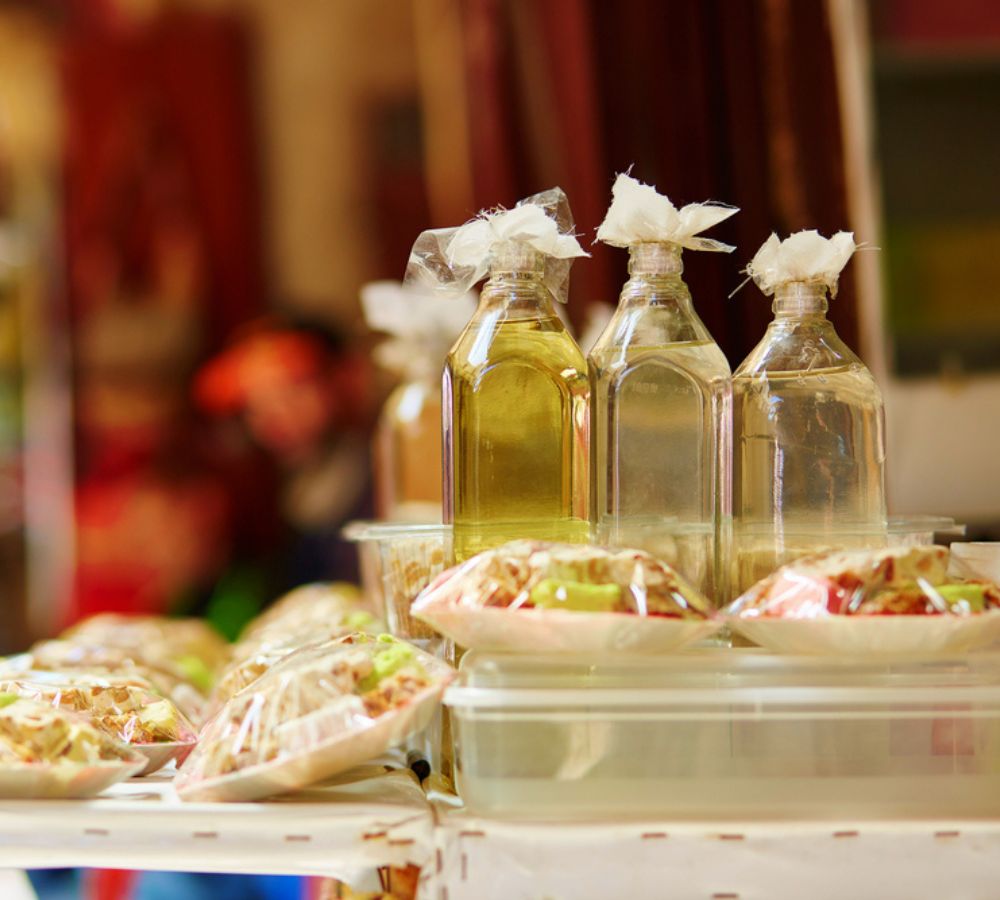
You’ll find this commodity in every street, market and medina in the country. Not only is it a fantastic addition to your skincare or hair routine, but you can also use it on pasta and bread.
Argan oil derives from argan fruit tree seeds. When goats eat them, these seeds are left behind.
These are cold pressed by teams of women who traditionally extract them by hand.
This makes it a very labour-intensive process to produce significant quantities of it.
Like with anything, the quality of the product will determine its price. However, for a premium cosmetic version of the oil, you can expect to pay around 150 dirhams for a 100 ml bottle.
Although it is a little pricey, it is still much cheaper than you would pay in the UK or anywhere else. So, for this reason, it makes a fantastic souvenir.
Leather Goods
Morocco is renowned for its leather tanneries. Its most famous is The Chouara Tannery in Fes, which dates back to the 11th century.
If you are into leather goods, several places in the country enable you to purchase them at very reasonable prices. Don’t worry, they are the real deal and not fakes!
Some leather goods products you can purchase include jackets, purses, wallets, poufs and babouches (more about them later).
At the Chouara Tannery, there are several rooms at its shop where you can pick up these stellar products. You will also find them at markets all over Marrakech, Casablanca, Adagir and Tangir.
Depending on their size, you can expect to pay around 150 dirhams for a top-quality leather purse or wallet.
Poofs will set you back around 200 – 300 dirhams, while leather jackets with lambskin linings start from about 1300 dirhams.
Babouches

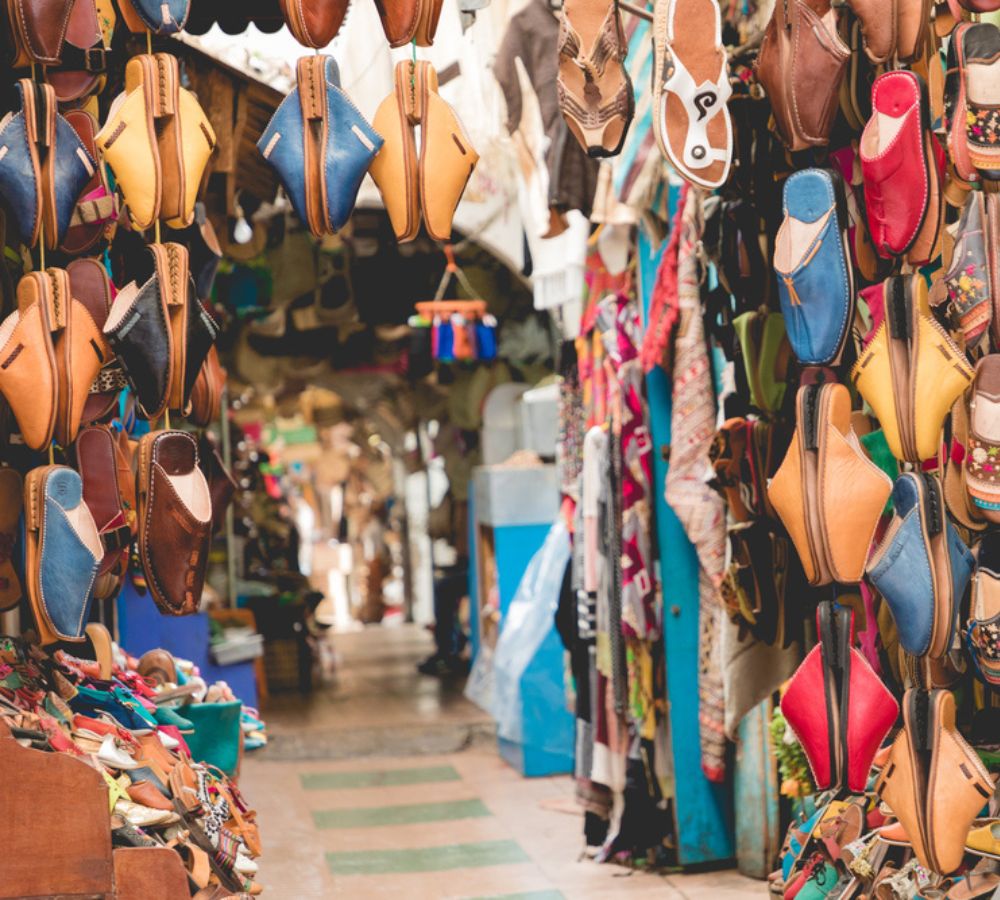
One of the coolest things to buy in Morocco is the babouches.
A traditional type of footwear, they were originally worn by a group of nomadic Arabic people called Bedouins who travelled around the northern part of Africa.
The shoe features an elongated pointy toe that soon turned into a notable fashion statement.
This type of slipper is so popular in Marrakech (as well as other parts of Morocco) that an entire street called Le Souk Des Babouches is devoted to it.
Available in a range of bright colours and beautiful designs, the quality of this footwear does vary.
The best ones are handmade and stitched together.
Try and avoid the ones with glued soles, as they are more likely to fall apart.
The price of the babouches will vary on size, design, location and your ability to haggle with the sellers. However, you be able to get a very good pair for around 50 dirhams.
Teapots
Drinking tea is very much ingrained in the fabric of Moroccan society and locals love nothing more than sharing a cup over a chat with family and friends.
Throughout your time in Morocco, you will be offered a cup of tea everywhere you go. From restaurants and cafes to desert camps and riads.
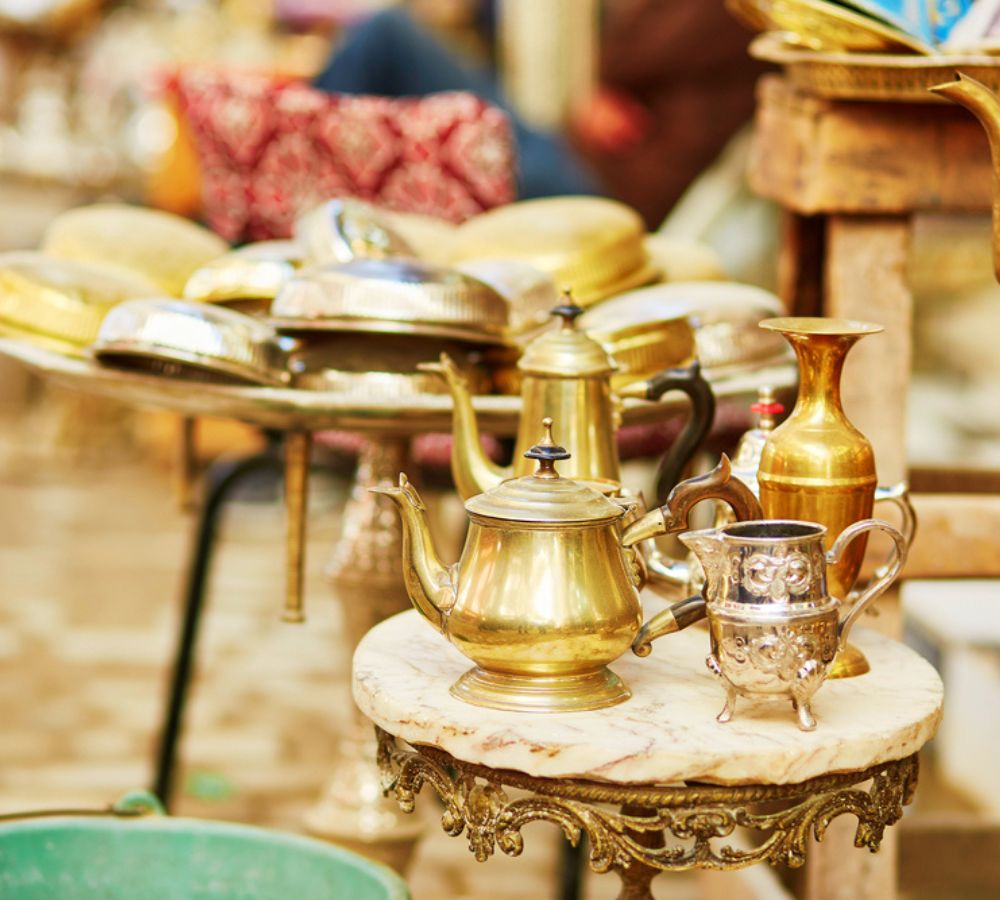
You won’t find PG tips here though. Instead, they offer a delicious mint version which they make in a traditional teapot that features a curved handle and rounded middle.
Often these teapots have a hinge and a decorative top, which gives them a distinctive style.
These impressive teapots come in all shapes and sizes and are regularly matched with cups and platters.
As a rule, the heavier the pot, the better the quality. A good quality one should set you back around 150 dirhams.
Even if you don’t buy them to make tea, they make terrific ornaments.
Wicker Bags
If your Instagram feed is full of Boho-style trends, then you’ll love the opportunities Morocco gives you to add some pieces to your homewares.
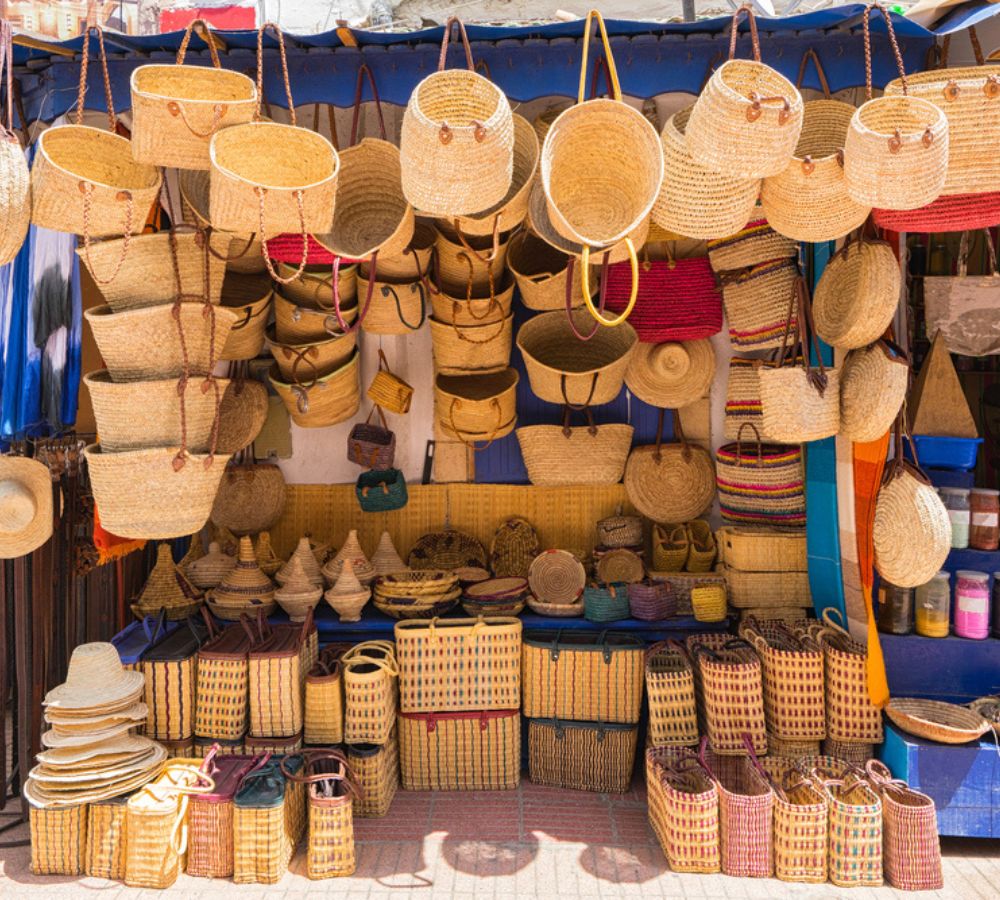
Wicker bags represent some of the best buys in Morocco, and you’ll find a massive range of them throughout the country.
In fact, there are so many of them to choose you’ll struggle to settle on the best one. So don’t be surprised if you buy a few of them!
Basket weaving is a time-honoured Moroccan tradition, and you can use these bags for laundry, decoration or storage.
They come in a host of sizes and shapes and feature designs that range from outlandish to understated.
If you want, they can even be customised with tassels, embroidery or pompoms as you wish.
Should you visit Marrakech, be sure to check out the souk that resides near Cafe de Epices.
You will be able to pick up a big-sized bag for only about 100 dirhams.
Silver Jewellery
In Morocco, silver jewellery is a bit part of the locals’ identity, and most women adorn some kind of silver jewellery.
Either round their necks, as rings or as a hair decoration.
Silver is prevalent in Morocco because it is the leading producer of silver concentrates and ore in Africa.
Therefore, the best place in the continent to purchase this type of jewellery is in the souks and shops of Morocco’s major cities.
Throughout them you will find a fantastic range of pieces that feature some of the most intricate designs you could ever hope to see.
Indeed, you could easily spend have a day in a jewellery shop looking at the Berber necklaces or silver bracelets in their display cabinets.
Again, prices and quality do vary and there are a lot of fakes around.
So remember, if you sniff the jewellery and smell a metallic fragrance, it is most likely a fake.
Tajines

One of the most popular souvenirs to buy in Morocco are tajines.
These earthenware dishes are used to prepare many of the country’s favourite national dishes.
They typically consist of a shallow base and have a cone-shaped top which facilitates a very hot and steamed cooking environment.
The word ‘tajine’ can also refer to the actual meal that is being cooked inside of it.
Typically, this will include a meat element like beef, lamb or chicken and a selection of vegetables such as onions, carrots or zucchini.
Plenty of spices will also be added to enhance its flavour and in homes and at restaurants, this meal is often served with couscous.
Tajines come in various sizes and colourful designs.
They can also be glazed or unglazed and are surprisingly inexpensive.
Costing only around 40 dirhams for an unglazed, medium-sized version.
You’ll find them in markets, roadside stalls and shops pretty much everywhere you go.
Rugs and carpets
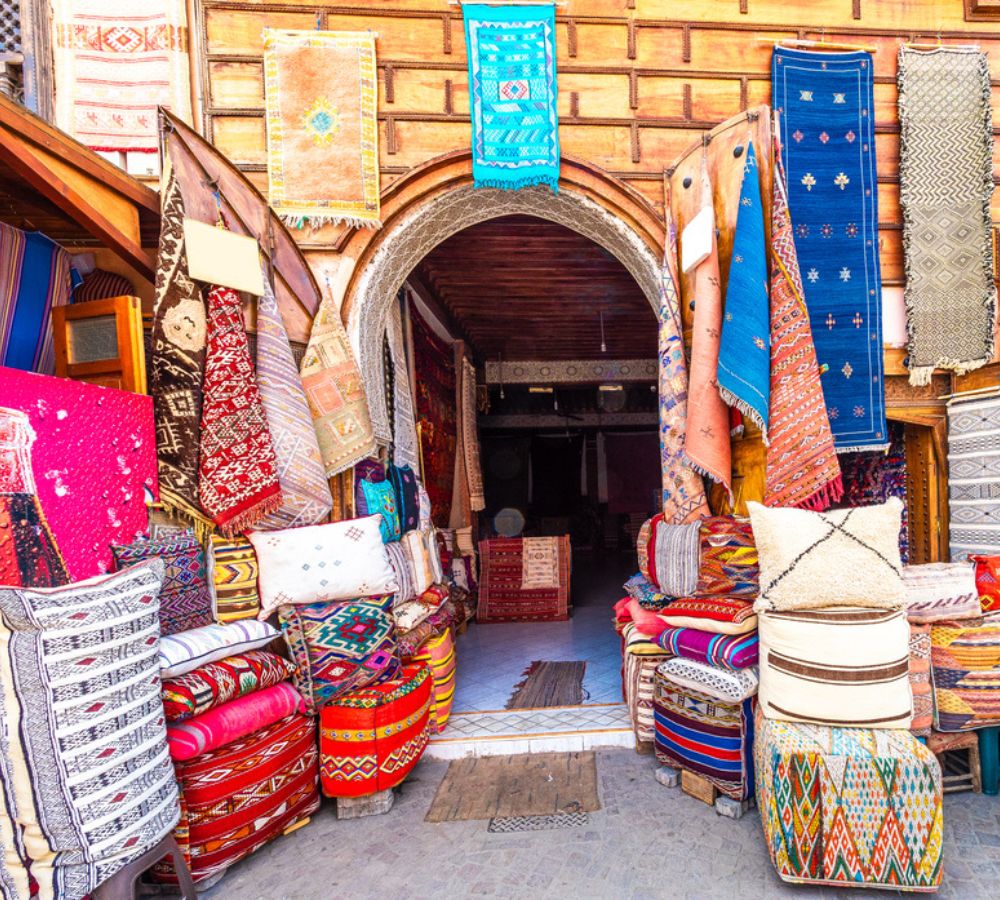
Traditionally used in sacred places and palaces, Morocco has a rich tradition of producing one-of-a-kind luxury carpets.
Dating back to around 622 AD, they were initially woven in the Sahara and North Africa by Berber women.
Good quality Moroccan carpets are incredibly mesmeric and beautiful and will hold pride of place in your home should you buy one.
They are available in most souks throughout the country, with small ones costing around 900 to 1000 dirhams.
If you are after a larger one with an intricate design, the prices will start from about 2000 dirhams.
Should you want to purchase a rug, there is a common scam you should look out for.
It involves the charming salesman taking your chosen carpet into a back room to be packaged up – only for another inferior version to be wrapped instead.
Therefore, to be on the safe side, ask the salesman to wrap it up in front of you.
Lanterns
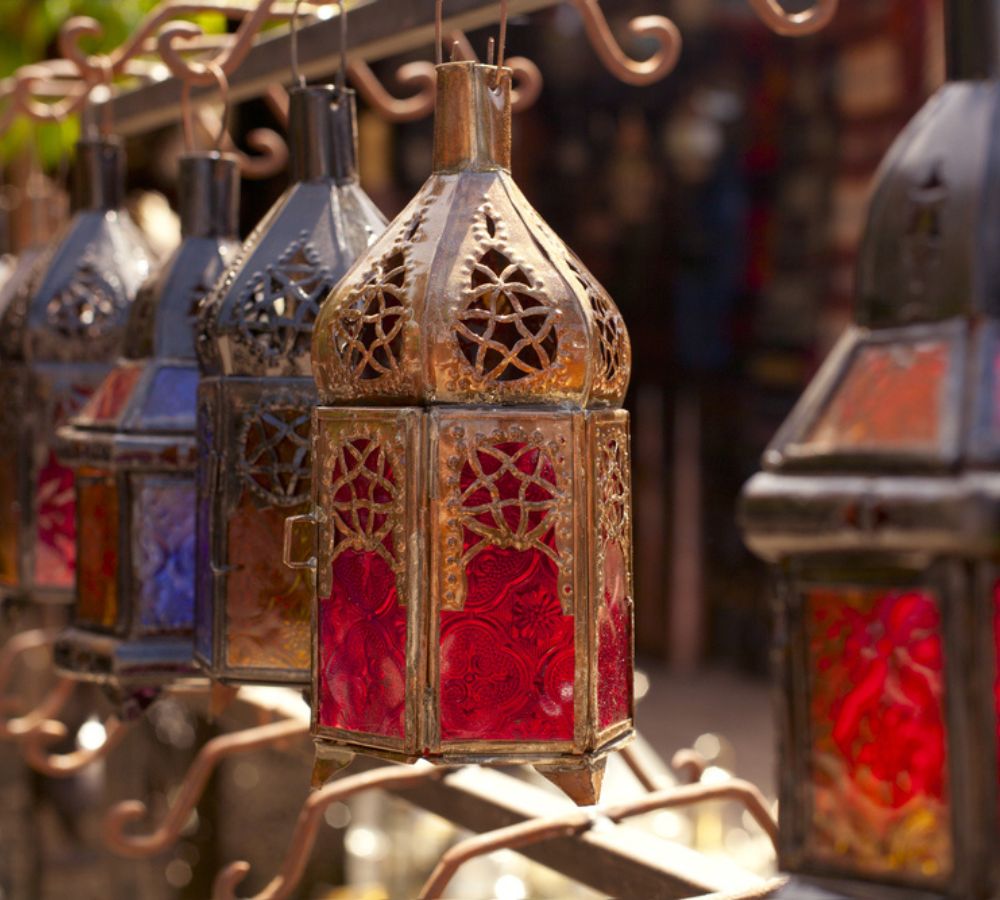
In Morocco, there is a rich tradition of metalwork. It is showcased in its mosques, hammams, courtyard houses and merdersas.
It is also evident in their brass lanterns. So, if you are wondering what can I bring back from Morocco? Consider getting one of them as an ornament for your mantlepiece or display cupboard.
Some of the lanterns are particularly enticing. They take the form of several shapes, sizes and designs, with many including coloured glass and ornate designs.
You will even find types embossed with hundreds of small holes, which have the magical effect of glowing in the dark.
A small lantern made of aluminium will cost around 100 dirhams. By contrast, a top-of-the-line brass lantern will be between 500 to 1500 dirhams.
As well as the lanterns, you will also find lots of varieties of chandeliers and oil lamps. Both range from cheap and kitschy to fabulous antique styles.
Spices
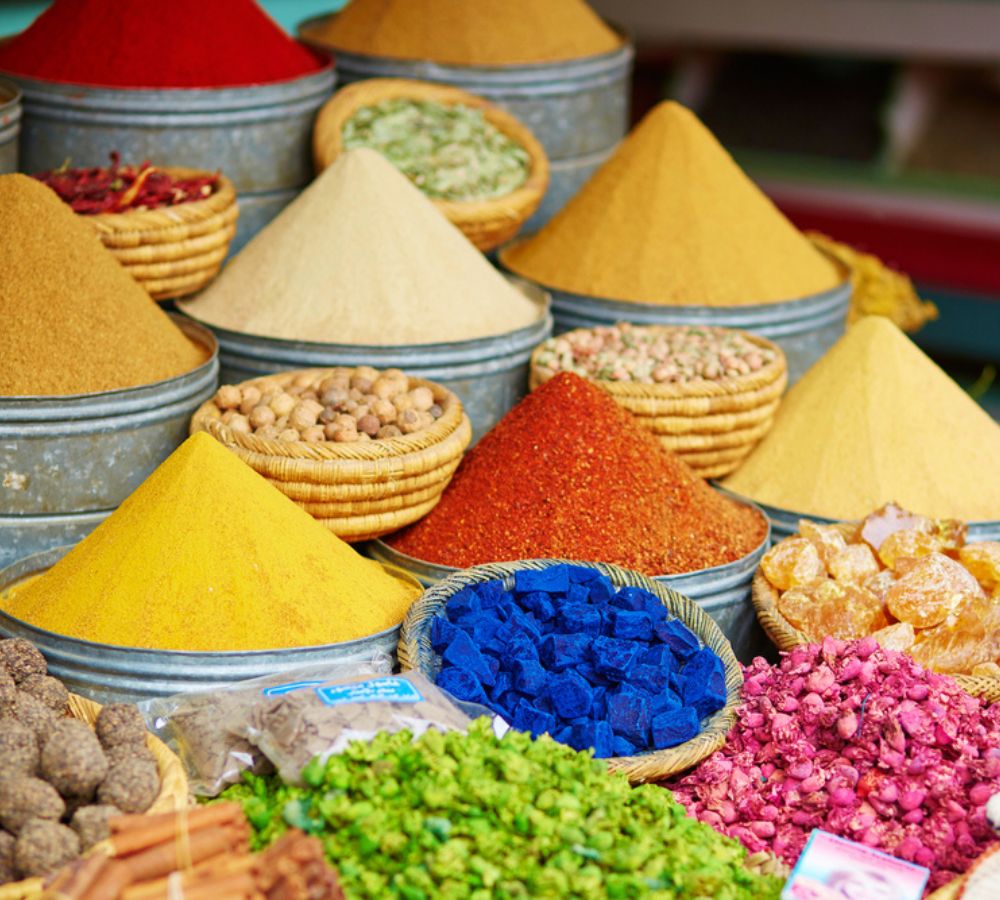
Go to any souk in Morocco, and you will come across a massive range of spices.
Covering every colour in the spectrum, these spices are presented in barrels and provide an intoxicating visual and olfactory treat.
Spices are an integral part of the Moroccan cuisine you enjoy when you visit the country.
They also are renowned for their medicinal properties, so make a great choice of gift for friends or family back home.
Ten of the most popular spices to look out for are aniseed (nafaa), black pepper (elbezar), cayenne (felfla), cinnamon (karfa), cumin (kamoon), ginger (skinjbir), paprika (felfla hlouwa), saffron (zafrane), sesame seeds (jinjelan) and turmeric (quekoum).
While some of these spices may be imported from the far east, most of them are locally cultivated.
A good price to pay is about 10 dirhams for 50 grams. Just make sure they are sealed and labelled, otherwise, they might not get past customs when you go home.
Artisanal Soap
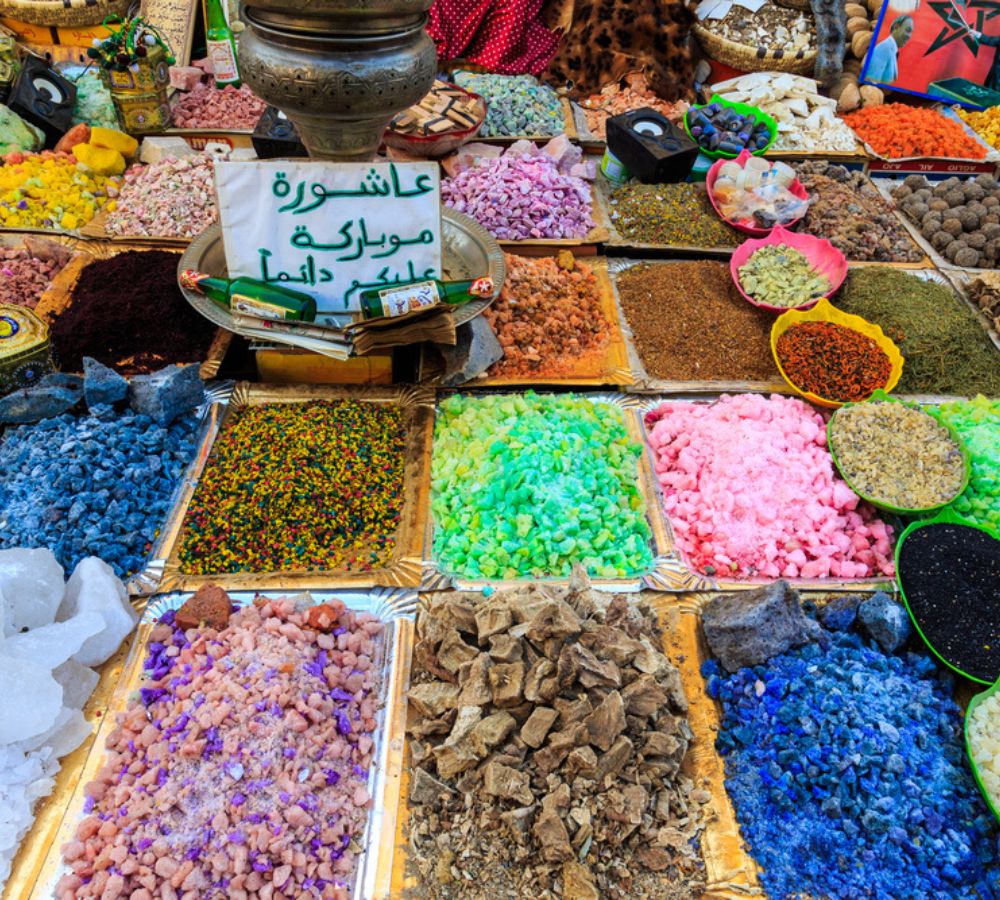
One of the best things to buy in Morocco for yourself is artisanal soap.
If you have never had the pleasure of using Moroccan black soap when bathing, then your skin is in for a treat.
Handmade, these soaps are a high-alkaline style of castile soap. High in Vitamin E, they are made from macerated olives and olive oil and have a somewhat gel-like consistency.
Originating from the hammams, Moroccan women use this black-coloured soap to cleanse, moisturise and exfoliate their skin.
It is a fabulous way to remove dead skin, and they do it with a kessa.
A coarse type of washcloth which they use about 5 to 10 minutes after rubbing the soap on their skin.
These soaps are available in all souks and small cosmetic shops across the country.
You can expect to pay around 40 to 50 dirhams per individual bar if buying these natural soaps in one of the bigger cities.
Moroccan Pottery

Thanks in part to its exceptional quality of clay, Morocco is renowned for its incredible pottery tradition.
Dating back to the 12th century it is especially prevalent in the cities of Meknes, Fez and Safi which have served as its main production centres.
In each of them, as well as in the major souks of Marrakech, you can buy a wonderful range of bowls, cups, plates and other pottery items.
Many of these items are turned into eye-catching ceramics which you might want to take home with you.
The best and most authentic ones are hand-made and have delightful patterns on them.
The easiest way to tell if they are hand-made is to see if they have any imperfections on them. If they do, then the chances are they are handmade.
If you purchase them outside of the big cities, you can pick up small bowls for around 20 dirhams and larger pieces for about 300 dirhams.
Breadbasket
When it comes to what souvenirs to buy in Morocco, you can’t go wrong with a breadbasket.
Whenever you dine at a restaurant or a local Moroccan home, the chances are the bread will be presented in one of them.
You are also bound to see these woven baskets at any souk or marketplace you visit.
Varying from those which have bright-coloured designs to others that are just plain, these baskets have been part of Moroccan culture for hundreds of years.
Handcrafted using wool and straw, these baskets can also feature pom-poms on top of them.
Designed to stop bread or pastries from drying out, they can be used as decorative furnishings or to store valuable jewellery.
The baskets are made all over Morocco but traditionally hail from the northern part of the country.
They vary in price depending on what style you buy. But 50 dirhams should get you a good quality one.
Scarves

Renowned for their vibrant colours and gorgeous material, scarves are one of the most popular Moroccan souvenirs.
Men and women across the country wear them as turbans.
They are especially good at staving off the heat and sand in the Sahara.
These scarves come in a dazzling area of colours and several different lengths. You will find them readily available in souks throughout the country.
The traditional colour that Moroccans wear is blue.
The exception to this is the Merzouga region, where they sport black scarves with contrasting embroidery in neon colours.
All other colours are essentially made for tourists.
The price varies on the material used and the length of the scarf. However, it should cost you approximately 65 dirhams.
If you are not familiar with how to put them on, the shop owner will show you how to do so. (It might be worth taking a video of this).
Tea
Even if you don’t buy a teapot, it is a good idea to purchase some tea when you are in Morocco.
Regarded as the drink of friendship, tea is a major part of Moroccan hospitality and culture. As such, mint tea is served at every opportunity in the country.
There is a strong chance it will be offered to you several times a day.
Should you accept anyone’s offer, tea is generally served quite sweetly. So, it might be a good idea to ask for it without sugar.
In most of the main cities and towns, you will find teashops or souk stalls that offer several varieties of loose-leaf tea.
If you don’t fancy mint tea, other types of tea you might want to purchase include green tea and Maghrebi mint tea.
Tea comes in various sizes, but a small bag of 100 grams could cost you about 20 dirhams.
Rose water

The Rose is Morocco’s National flower, and you will see plenty of beautiful examples of them for sale in the various medinas, souks and marketplaces you visit.
For hundreds of years, they have played an important role in weddings, romantic gestures, sacred ceremonies and formal occasions in Morocco.
While you won’t be able to buy flowers as souvenirs from Morocco, you can purchase bottles of rose oil or water to take home.
These are very good for your skin as they help to reinforce its barrier.
It may surprise you that 10,000 roses are required to make just 5 ml of oil or water.
The cost and quality can vary depending on whether it has been distilled or extracted.
Distilled tends to be more expensive, while extracted oil often has a much stronger scent.
You can buy them for about 250 dirhams for a 10 ml bottle. Which type you choose is a matter of personal taste.
Wooden boxes

Around the different souks and marketplaces of Morocco and especially in Essaouira, you’ll see lots of traditional wooden jewellery boxes.
Made out of Thuya wood – which is indigenous to the country – they often feature ornate inlays of mother of pearl, bone, aluminium wire and other materials.
As well as their aesthetic beauty, these boxes have an intrigue to them.
Many of them come with puzzle-style designs, which means they are not easy for others to open.
They also often have secret compartments to hide your valuables.
Traditionally carried around by the nomads, they are also known as Camel Mystery Boxes.
Today they are often locally made by artisan craftsmen. Many of them work on the roadside with foot- or hand-powered carving tools.
Their quality might vary between stalls. But overall, the standard of workmanship is very good. Some boxes you can pick up for only 20 dirhams.
Although, a more intricate design will set you back around 100 dirhams.
We hope this article helped you in your search and that you will enjoy shopping for your souvenirs of Morocco. Have fun!
You may also be interested in:
