
Disclosure: This post may contain affiliate links, meaning I get a commission if you decide to make a purchase through my links, at no extra cost for you!
If you’re planning your first trip to Yellowstone and wondering how to make the most of it — three days is the perfect (minimum) amount of time.
It gives you enough time to see all the major highlights without having to rush from one thing to the next.
I absolutely love Yellowstone and I think it’s one of the most beautiful places in the world so I can’t wait to help you build your own itinerary.
This itinerary starts and finishes in West Yellowstone, which is usually the most practical base. But it can easily be adapted to start from any of the other park entrances, like the North Entrance in Gardiner or the South Entrance coming from Grand Teton.
Let’s get into it!
Before You Start: A Few Things to Know
1. Start early every day
Yellowstone gets busy, and wildlife is most active at dawn.
The earlier you’re out, the better your chances of incredible sightings — and the more you’ll enjoy popular spots before the crowds arrive.
2. Get the Guide Along App

This is genuinely one of the best things you can do for your Yellowstone visit.
It’s an audio driving tour app — you download the Yellowstone package, plug your phone into the car, and as you drive, you get commentary and tips based on your location.
It’s not constant, so you can still enjoy the drive and chat, but whenever you reach something interesting, all the context is right there. Incredible value for money.
3. Sort your entrance fee
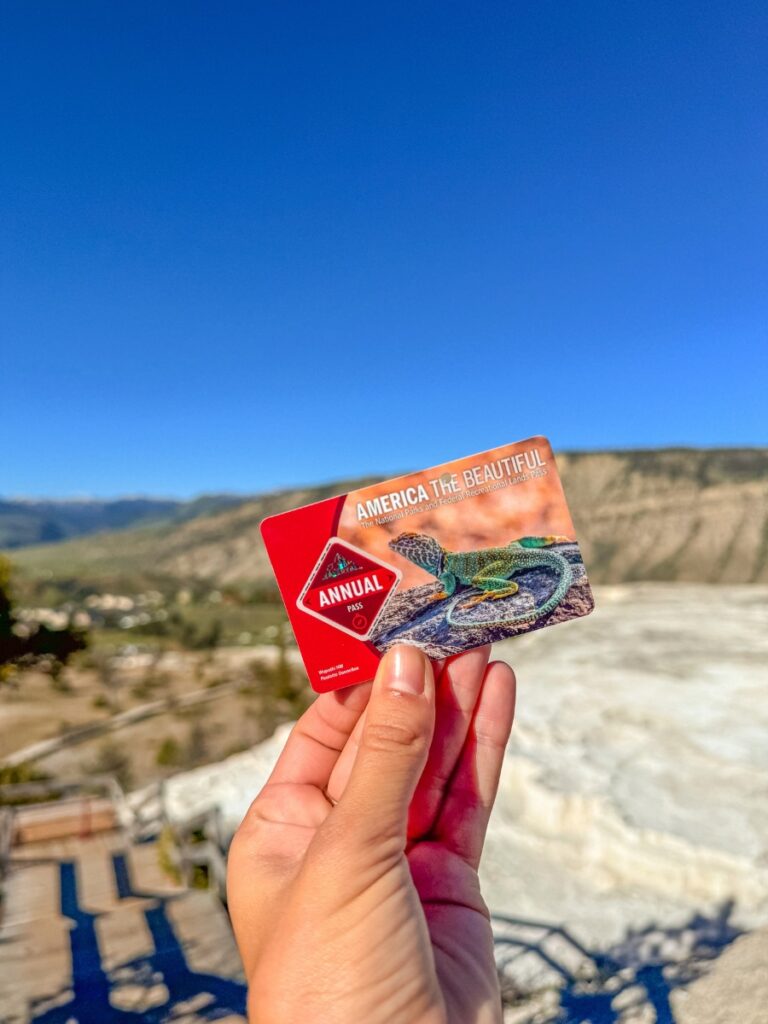
Entry to Yellowstone costs $35 per vehicle and is valid for 7 days.
If you’re also planning to visit Grand Teton or Glacier National Park on this trip, I’d strongly recommend getting the America the Beautiful Pass instead ($80/year).
It covers entry to all national parks across the US, so it very quickly pays for itself.
You can get it online or at the entrance of the park.
Please note that different prices apply for non-US citizens.
4. Fill up on gas in West Yellowstone
Gas inside the park is significantly more expensive. Fill up before you enter.
5. Pack a picnic
There are a few food options inside the park but they’re limited and pricey.
Bringing your own lunch means you can eat at a beautiful viewpoint and keep moving.
That said, always keep it in your car as there are bears and I wouldn’t recommend walking around with food.
Day 1: West Yellowstone to Mammoth Hot Springs
Today you’ll drive the upper western section of the Grand Loop, taking in geysers, hot springs, dramatic cliffs, and finishing at one of the most spectacular thermal features in the park.
It’s a full day but not a rushed one — the stops are mostly quick-to-moderate, with Norris Geyser Basin and Mammoth Hot Springs being the two big highlights.
Stop 1: West Yellowstone

Start your day in West Yellowstone, just outside the West Entrance to the park.
Get gas here if you haven’t already, grab coffees and snacks for the road, and head to the entrance.
If you have an America the Beautiful Pass, simply show it with your ID. Otherwise, you can get it there.
💡 PRO TIP: If you’re using the Guide Along App, make sure it’s downloaded and the Yellowstone package is ready to go before you enter the park. Signal can be very patchy inside, so it’s much easier to have everything set up in advance.
Stop 2: Gibbon Falls
🚗 Driving time from West Yellowstone: ~45 min
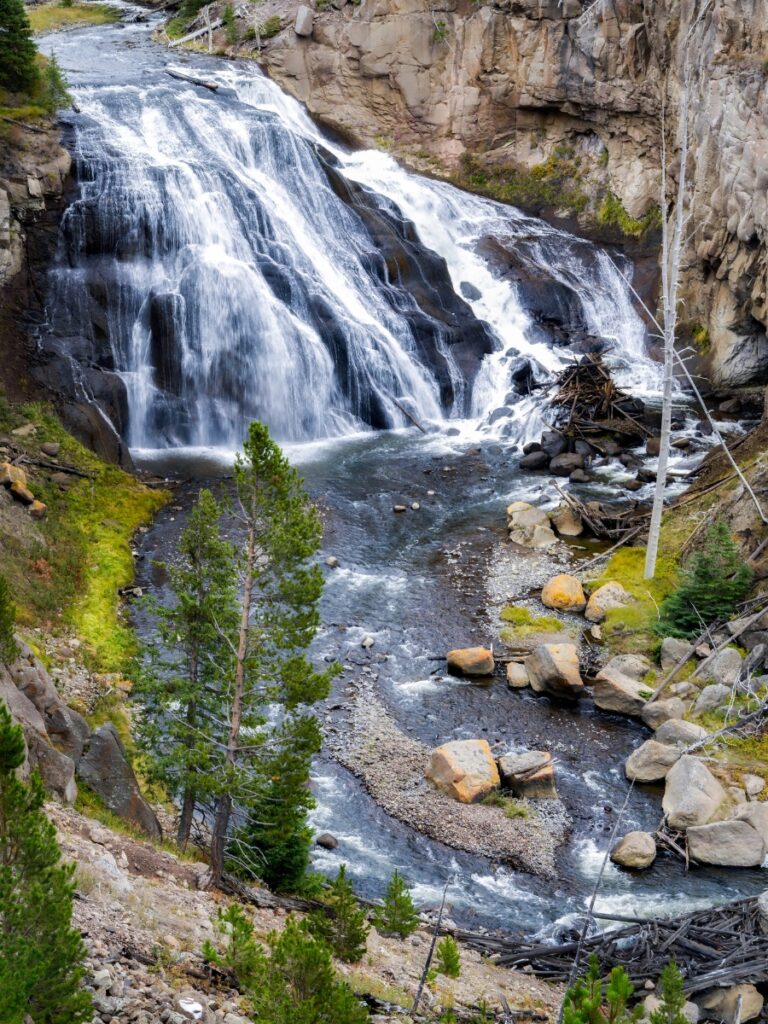
Your first stop is Gibbon Falls, a beautiful 84-foot waterfall on the Gibbon River.
What makes it particularly interesting is what you’re actually looking at: the falls drop over a remnant of the Yellowstone caldera rim — the edge of the massive volcanic crater created by an eruption approximately 631,000 years ago.
You can walk down the path, there are a couple of viewpoints.
Stop 3: Artists’ Paintpots
🚗 Driving time from Gibbon Falls: ~10 min
Not to be confused with the Fountain Paint Pots further south in the park, the Artists’ Paintpots are a separate and very worthwhile stop.
There’s a one-mile trail here that takes you through a variety of hydrothermal features — colorful hot springs, steaming fumaroles, and the bubbling, gurgling mud pots that give this place its name.
The mud pots are particularly fascinating. They look like something out of another planet.
💡 PRO TIP: Wear sturdy walking shoes for this trail. The path can be uneven and there are a few gentle uphill sections.
Stop 4: Norris Geyser Basin

🚗 Driving time from Artists’ Paintpots: ~10 min
This is one of the highlights of Day 1 — and honestly one of the highlights of the entire park in my opinion.
Norris Geyser Basin is the hottest and oldest geyser basin in Yellowstone.
The landscape here is almost otherworldly — white and grey and steaming, with bright blue pools scattered throughout.
There are two loop walks: the Porcelain Basin loop and the Back Basin loop.
If you have time, I’d recommend doing both.
But if you’re short on time, head to the top of the Porcelain Basin first for stunning panoramic views of the entire basin, then head to the Back Basin to find the Steamboat Geyser, the tallest active geyser in the world.
It’s unpredictable and you probably won’t catch an eruption, but it’s still impressive to see.
💡 PRO TIP: Check out my full guide to the most beautiful places in Yellowstone for more on what makes Norris so special.
Stop 5: Roaring Mountain
🚗 Driving time from Norris: ~15 min
Roaring Mountain is a quick but fascinating roadside stop on your way north.
It’s a large hillside covered in fumaroles that hiss and bubble away at the surface. In the late 1800s and early 1900s, the fumaroles here were apparently so powerful they literally roared, which is how it got its name.
They’re quieter now, but it’s still a striking sight.
If you’re using the Guide Along App, they will tell you everything about it! This one wasn’t part of my initial planning and I stopped after the tour guide recommended it.
Stop 6: Sheepeater Cliff

🚗 Driving time from Roaring Mountain: ~15 min
Another quick stop, and one that was actually recommended to me by the Guide Along App — so worth the mention!
Sheepeater Cliff is made up of dramatic columns of basalt, formed by lava flows around 500,000 years ago. The columns are incredibly geometric and beautiful, and the Gardner River running through the valley below adds to the scenery.
Also, there were various rodents running around the columns including yellow-bellied marmots which I thought was really cool!
Stop 7: Golden Gate Canyon
🚗 Driving time from Sheepeater Cliff: ~10 min
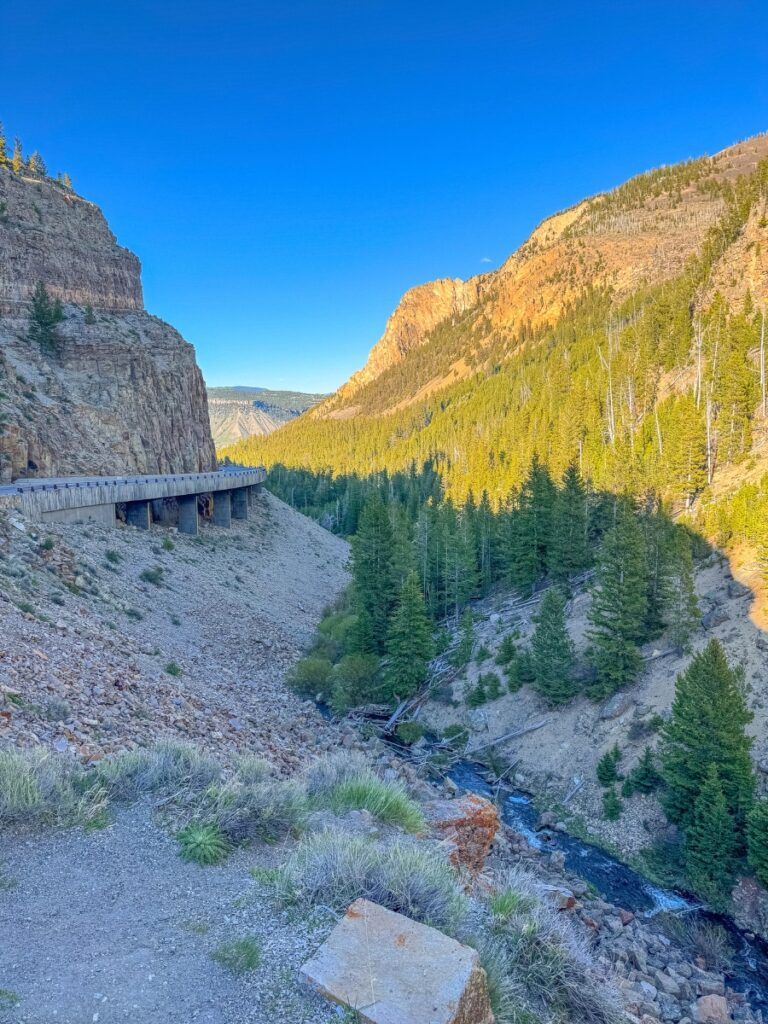
Golden Gate Canyon is more of a scenic drive-through than a traditional stop, but it’s absolutely worth slowing down and taking it in.
The road here passes through a narrow canyon on a historic viaduct — a 200-foot concrete bridge built into the cliff wall in the early 1900s. It’s an impressive piece of engineering, and the canyon itself is gorgeous.
There are a few places where you can pull over and take in the views but be careful if there are a lot of people on the road as you do not want to park somewhere you shouldn’t and create a traffic jam.
Stop 8: Mammoth Hot Springs

🚗 Driving time from Golden Gate Canyon: ~5 min
And here’s the big finish for Day 1 — Mammoth Hot Springs.
Mammoth is completely different from anything else you’ll see in Yellowstone. Instead of the geysers and colorful hot pools you’ve been seeing all day, here you get vast terraced limestone formations — pale white and cream and orange.
It’s unlike anywhere else on earth.
There’s a boardwalk that takes you around the terraces, both on the lower and upper levels. Set aside a good couple of hours — there’s a lot to take in, and you’ll want to explore both levels.
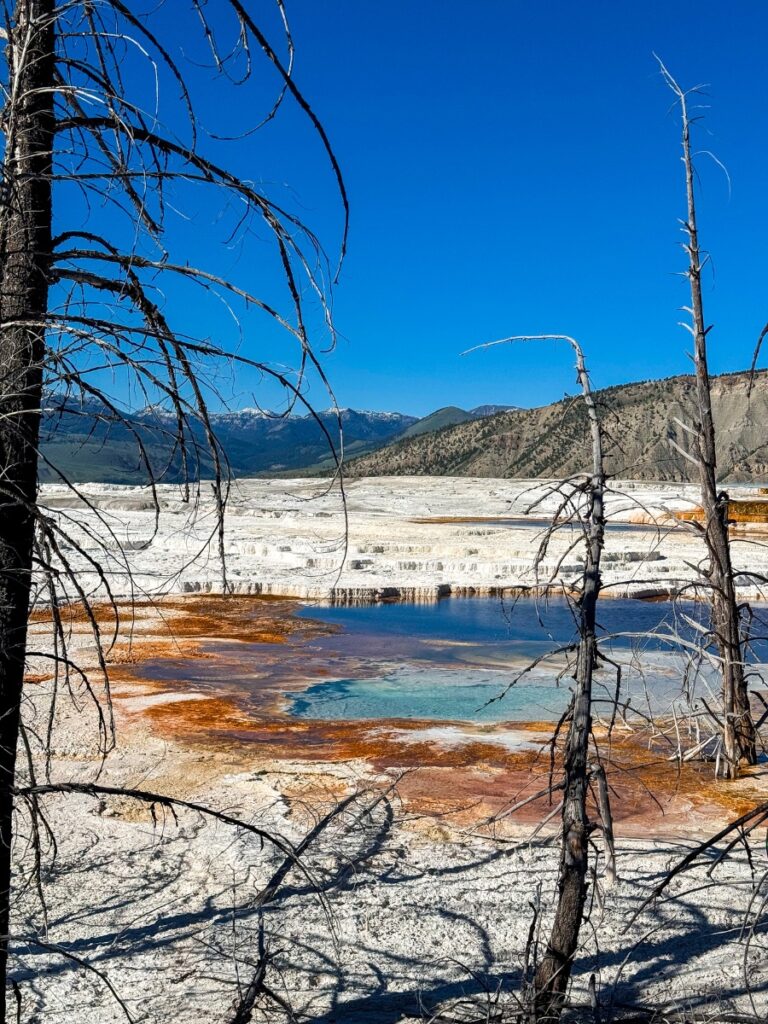
Also, make sure to check out Liberty Cap (a tall cone-shaped formation near the parking area).
💡 PRO TIP: Make sure to visit the Mammoth Hot Springs visitor center if you have time. It’s one of the best in the park, the rangers are excellent, and you can get your national park passport stamp here.
💡 PRO TIP 2: There is little to no shade at Mammoth Hot Springs so make sure you wear a hat and put sunscreen on. The sun can be quite strong and the reflection against the white terraces makes it worse too.
Where to Stay in Yellowstone After Day 1
The most convenient option is Mammoth Hot Springs itself, which has lodges and a campground right in the park.
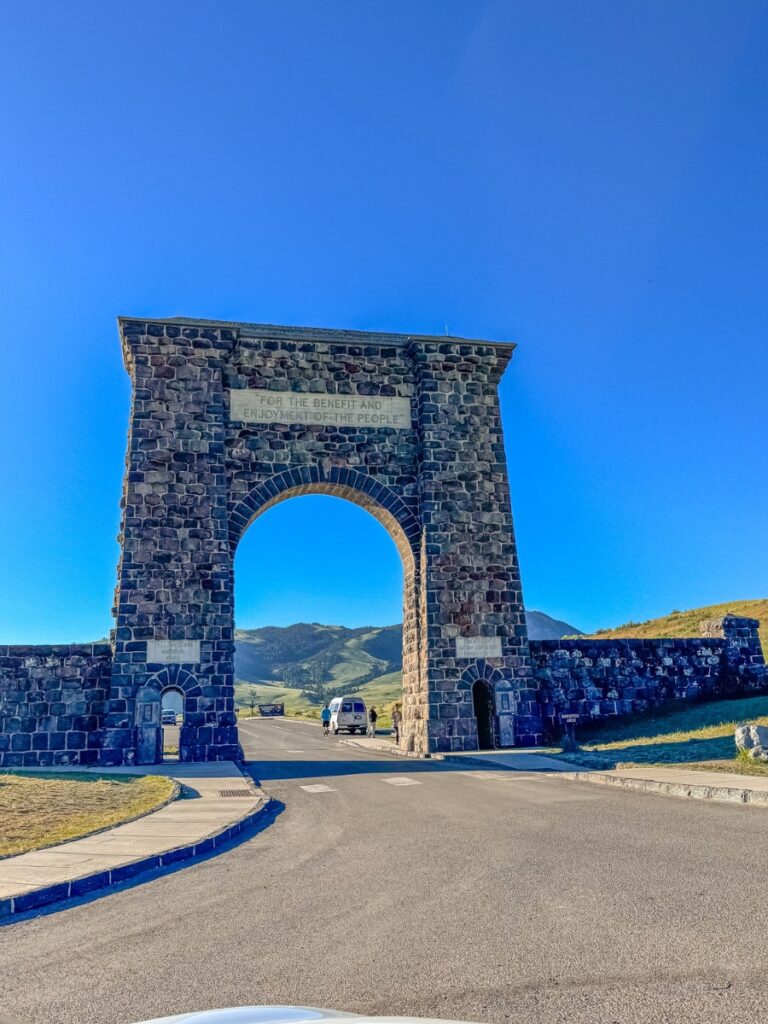
If you’re looking for something cheaper, Gardiner (the town just outside the North Entrance) has more budget-friendly options — and the bonus is that you’ll drive through the iconic Roosevelt Arch on your way in the next morning, which is a lovely start to Day 2.
The drive from Gardiner back into the park adds about 15 minutes but it’s worth it to save money.
💡 PRO TIP: Wherever you stay, book well in advance — even for shoulder season. Accommodation in and around Yellowstone fills up fast.
Day 2: Lamar Valley, Grand Canyon & Yellowstone Lake
Today is the big one as you’ll be covering a lot of ground but it’s well worth it.
I would recommend starting early in the morning so you can see everything and also get to see as many animals as possible in the Lamar Valley.
If you’re staying in Gardiner: Drive through the Roosevelt Arch on your way into the park.
It was historically the main gateway to Yellowstone — President Roosevelt himself laid the cornerstone — and it’s a lovely way to start the day.
Stop 1: Petrified Tree

🚗 Driving time from Mammoth: ~30 min
A very quick but cool stop on your way east.
The Petrified Tree is a 50-million-year-old redwood tree that was buried by a volcanic eruption and slowly turned to stone over time.
It’s fenced off to protect it, but you can get close enough to see it clearly.
It takes only a few minutes and it’s a fascinating little piece of history before the day really gets going.
Stop 2: Lamar Valley (Detour — but Worth It!)

🚗 Driving time from Petrified Tree: ~20 min to the start of the valley
This is technically a detour from the main loop, but it is absolutely worth it.
Lamar Valley is one of the best wildlife-watching spots in the entire national park system — not just Yellowstone.
As you drive through the valley, you’ll see bison in huge numbers, grazing across the wide open landscape. It’s breathtaking.
There’s also a real chance of spotting bears, elk, and if you’re very lucky, wolves.
I was driving through the valley when I noticed a bunch of cars pulled over on the side of the road. We stopped and asked what everyone was looking at. It was a wolf. A wolf! One of the rarest sightings you can have in Yellowstone.
I had no binoculars and could barely see it — but a very kind man lent me his and I eventually spotted it. Lesson learned. Always bring binoculars to Yellowstone!
You don’t need to drive all the way to the Northeast Entrance. Drive in as far as feels right, then turn around and head back to the main loop.
💡 PRO TIP: If you see cars stopped on the side of the road in Yellowstone, always pull over and ask what they’re looking at if you can’t see it yourself. It’s usually something special. Remember: stay at least 25 yards from bison and elk, and 100 yards from bears and wolves.
Stop 3: Calcite Springs Overlook

🚗 Driving time from Lamar Valley: ~30 min
Back on the main loop and heading south, you’ll reach the Calcite Springs Overlook.
This one is short and sweet.
There’s a very short boardwalk that takes you to a viewpoint in just a couple of minutes, and the views are genuinely stunning — you can see deep into the canyon carved by the Yellowstone River, with steam rising from hydrothermal vents along the white rock walls.
It’s not the most famous stop in the park, but it’s beautiful and very underrated.
Stop 4: Tower Fall

🚗 Driving time from Calcite Springs: ~5 min
Just a few minutes down the road, you’ll find Tower Fall.
The waterfall plunges 132 feet and the walk from the parking area to the viewpoint takes about 2-5 minutes.
There’s also a small general store here if you need snacks or souvenirs.
Stop 5: Brink of the Lower Falls

🚗 Driving time from Tower Fall: ~45 min
Just at the entrance of the North Rim drive, there’s a parking lot that leads to the Brink of the Lower Falls — a platform right at the top of the waterfall.
The walk takes a few minutes and brings you to a spot where you can see the water thundering over the edge just feet in front of you.
The power and speed of it is genuinely impressive. It’s a completely different perspective from the overlooks.
While the walk is short, it’s important to note that it goes downhill quite a bit.
Stop 6: Grand Canyon of the Yellowstone — North Rim

🚗 Driving time from the Brink of the Lower Falls: ~5 min
Okay, let me be honest with you: I had absolutely no idea the Grand Canyon of the Yellowstone was going to be as incredible as it is. I was not prepared.
It is stunning. Jaw-droppingly, can’t-stop-staring stunning.
The canyon is 24 miles long and the colors of the rock — deep golds and oranges and yellows — are incredible. And then there are the waterfalls. The Lower Falls drop 308 feet into the canyon below, and the views from the North Rim are some of the best in the park.
On the North Rim drive, the key stops are:
The Lower Falls Overlook — the best view of the falls from this side. Well worth the short walk down from the parking area.
Grand View — a wider lookout that shows more of the canyon and the river snaking below.
Inspiration Point — the last viewpoint on the North Rim drive, with sweeping views of the canyon. Don’t skip it.
💡 PRO TIP: The North Rim drive is a one-way road, so follow the signs carefully. You’ll naturally flow through all the viewpoints before reaching Canyon Village.
Stop 7: Canyon Village
🚗 Driving time from North Rim: ~10 min
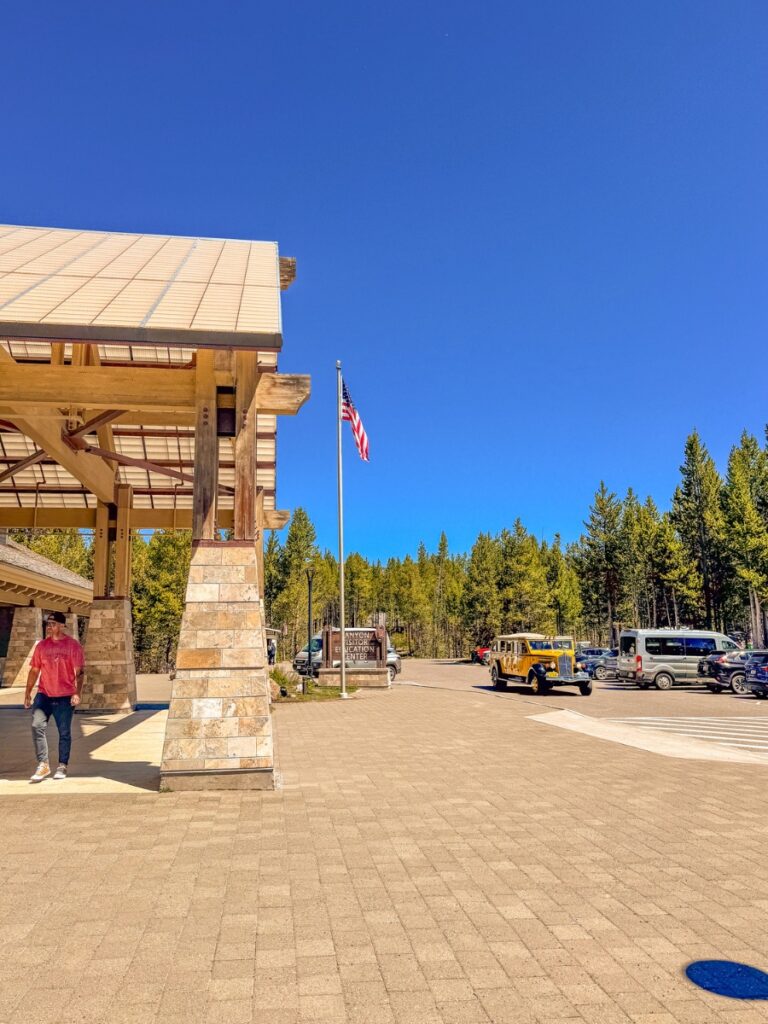
Canyon Village is one of the main hubs in the park.
The visitor center here is excellent — one of the best in Yellowstone, actually. There’s a really interesting geology exhibition, and the rangers are knowledgeable and happy to chat.
You can also get your national park passport stamp here.
There’s also a shop and a café, so if you didn’t pack a picnic, grab something to eat here. The merch store is quite big so if you were planning on buying some it could be a great time. That’s where I got my Yellowstone cap from.
Stop 8: Grand Canyon of the Yellowstone — South Rim

🚗 Driving time from Canyon Village: ~10 min
Don’t be tempted to skip the South Rim just because you’ve already seen the canyon from the North.
The views are completely different, and the South Rim has the best viewpoint in all of Yellowstone.
Artist Point is at the end of the South Rim drive, and it is spectacular.
You can see the full sweep of the Lower Falls and the canyon stretching out below — it’s the kind of view that makes you understand why painters have been coming here for over a century.
💡 PRO TIP: If you have extra time and energy, the Point Sublime hike starts near Artist Point.
It’s a 2.6-mile round trip and a fairly easy hike, with even more incredible views.
I wouldn’t necessarily recommend it if you’re following the full itinerary on this day, but if you have a more relaxed schedule or an extra day, it’s a wonderful addition.
Stop 9: Hayden Valley

🚗 Driving time from South Rim: ~20 min
Hayden Valley is another excellent wildlife-watching area — similar to Lamar Valley but right on the main loop.
Bison are often seen here in large numbers, and bears have been spotted frequently too.
Drive slowly, keep your eyes open, and pull over safely if you see anything.
Even if there’s no wildlife, the valley itself is beautiful — wide open, green, and peaceful. There are a few places where you can stop so it’s a great quick snack and coffee stop option (providing you brought it with you).
Stop 10: Sulphur Caldron & Mud Volcano

🚗 Driving time from Hayden Valley: ~5 min
First up is the Sulphur Caldron, a quick roadside stop just off the main road.
It’s one of the most acidic features in the entire park — the bright yellow color and the bubbling surface make it look almost radioactive. Worth a quick look.
About a minute further, there’s the parking area for the Mud Volcano.

The 0.6-mile boardwalk here is fascinating — boiling mud pots, hissing steam vents, and bubbling craters in every direction. It’s a slightly alien landscape and quite different from the other hydrothermal areas you’ve seen.
Allow about an hour to do the full loop.
Please note that bison are often seen in that area. When I went, there were quite a few so the park rangers had to close sections of the boardwalk.
We ended up doing the loop twice as they had reopened it by the time we finished the first time.
Stop 11: Yellowstone Lake

🚗 Driving time from Mud Volcano: ~20 min
As you drive south, you’ll reach the shores of Yellowstone Lake — the largest lake in the park at 136 square miles, and one of the largest high-altitude lakes in North America.
The scenery here is very different from everything else in Yellowstone. It’s calm, wide, and beautiful — mountains in the distance, the lake stretching out endlessly in front of you.
Stop at the Lake Village or the Fishing Bridge area to take it in.
If you have time and interest, there are cruises, fishing, and boating available here — but with this itinerary, a peaceful 20-30 minute stop is more realistic.
Stop 12: West Thumb Geyser Basin

🚗 Driving time from Yellowstone Lake: ~35 min
West Thumb is one of the most unique geyser basins in Yellowstone because it sits right on the shore of the lake.
The combination of colorful hot springs and geysers with the vast blue expanse of Yellowstone Lake behind them is unlike anything else in the park.
My favorite feature here is the Black Pool — which, despite its name, is a stunning shade of turquoise. The color of the water is incredible.

There’s a boardwalk that takes you around all the features and along the lakeshore. Set aside about an hour.
💡 PRO TIP: If you’ve had a really long day and are running out of energy by the time you reach West Thumb, it’s absolutely fine to skip it for tonight and do it first thing tomorrow morning on your way to Old Faithful. It’s right on the route and the morning light here is beautiful.
Where to Stay After Day 2
Stay somewhere in the Yellowstone Lake area — options include Lake Yellowstone Hotel, Lake Lodge Cabins, or Fishing Bridge RV Park.
Book well in advance as these fill up quickly, even outside of peak season.
Day 3: Old Faithful, Grand Prismatic & the Lower Geyser Basin
Last day — and what a day to finish on.
Today you’re covering the most famous icons of Yellowstone: Old Faithful, the Upper Geyser Basin, and Grand Prismatic Spring.
This is the area that most people picture when they think of Yellowstone, and it absolutely lives up to the hype.
You’ll end back in West Yellowstone, completing the loop.
Stop 1: Old Faithful

🚗 Driving time from Lake area: ~1.5 hours
Start your day at Old Faithful — and get there early.
This is one of the busiest areas of the entire park, and if you’re there first thing in the morning, you’ll have a much more enjoyable experience than if you arrive midday.
Old Faithful is the most predictable geyser in Yellowstone, erupting roughly every 90 minutes. The visitor center displays the predicted eruption time, so you can plan around it. You can also find it on the NPS website.
That said, it’s not an exact science — aim to be in position 10-15 minutes before the predicted time, just to be safe.
The eruptions last between 1.5 and 5 minutes and reach heights of 106-184 feet. It’s incredibly impressive.
And if you miss it, don’t worry, you can always go around the Upper Geyser basin and come back for the next one!
💡 PRO TIP: Try to stand upwind from Old Faithful — you’ll get clearer views and stay drier! And check out my full guide on tips for visiting Old Faithful before you go.
Stop 2: Upper Geyser Basin & Morning Glory Pool

🚗 Driving time from Old Faithful: Few minutes walk
Right after Old Faithful, start the walk through the Upper Geyser Basin — one of the most extraordinary places on the planet.
This area contains more geysers than anywhere else on Earth, with hundreds of hydrothermal features along the boardwalk.
You’ll pass Castle Geyser, Grand Geyser, Daisy Geyser, Riverside Geyser, and many more.
My personal favorite was Castle Geyser. The cone is absolutely beautiful, and if you’re lucky enough to catch an eruption, it lasts a really long time. Check the predicted times at the visitor center and try to time your visit with Castle if you can.

Walk all the way to the Morning Glory Pool at the end of the trail.
It’s a beautiful, vibrant pool of blues and greens and yellows, named after the flower it resembles. Make sure you go all the way there — it’s one of the most beautiful springs in the park.
💡 PRO TIP: Stay on the boardwalk at all times. The ground around the geysers and hot springs is extremely fragile and the water is dangerously hot.
Stop 3: Grand Prismatic Overlook

🚗 Driving time from Upper Geyser Basin: ~15 min
This is, without question, one of the most spectacular views in all of Yellowstone — and honestly one of the most beautiful things I’ve ever seen.
Park at the Fairy Falls trailhead (note: it’s a small parking lot, so arrive early or be patient).
From there, it’s about a 0.6-mile walk to the overlook platform — gentle uphill but nothing difficult. The whole thing takes about 20-30 minutes each way.
From the top, you can see Grand Prismatic Spring in all its glory — a massive, vivid rainbow of colors spreading out below you. Deep blue in the center, surrounded by rings of green, yellow, orange, and red.
It’s breathtaking, literally.
💡 PRO TIP: Try to visit the overlook around midday if you can. Early in the morning, steam can obscure the colors. As the sun gets higher and the steam burns off, the colors become much more vivid — you’ll get the photos you’re actually hoping for. For more tips, check out my complete guide to Grand Prismatic Spring.
Stop 4: Grand Prismatic Spring & Midway Geyser Basin

🚗 Driving time from Overlook: ~5 min
After the overlook, drive the short distance to the Midway Geyser Basin parking area.
While the overlook gives you the perspective and the wow factor, walking the boardwalk at the basin gives you a completely different experience — you get to see Grand Prismatic up close, walk right alongside it, and feel the heat and steam rising off the water.
The colors are just as vivid up close, just in a different way.
The Excelsior Geyser Crater is also here and worth a look — it’s enormous and its brilliant blue water contrasts beautifully with the surrounding landscape.
💡 PRO TIP: It can get very windy in this part of the park. Hold onto your hat firmly — if it blows off the boardwalk, you won’t be able to retrieve it!
Stop 5: Fountain Paint Pots & Lower Geyser Basin

🚗 Driving time from Grand Prismatic: ~5 min
The Fountain Paint Pots are a brilliant final hydrothermal stop.
What makes this area special is that it showcases all four types of hydrothermal features found in Yellowstone — geysers, hot springs, mud pots, and fumaroles — all in one compact boardwalk trail.
The mud pots are particularly mesmerizing. They bubble and plop and gurgle, and the colors range from pale grey to vivid pink.
The boardwalk takes about 45 minutes to complete.
Stop 6: Firehole Falls & Firehole Canyon Road
🚗 Driving time from Fountain Paint Pots: ~10 min
This is a lovely final stop before heading back to West Yellowstone.
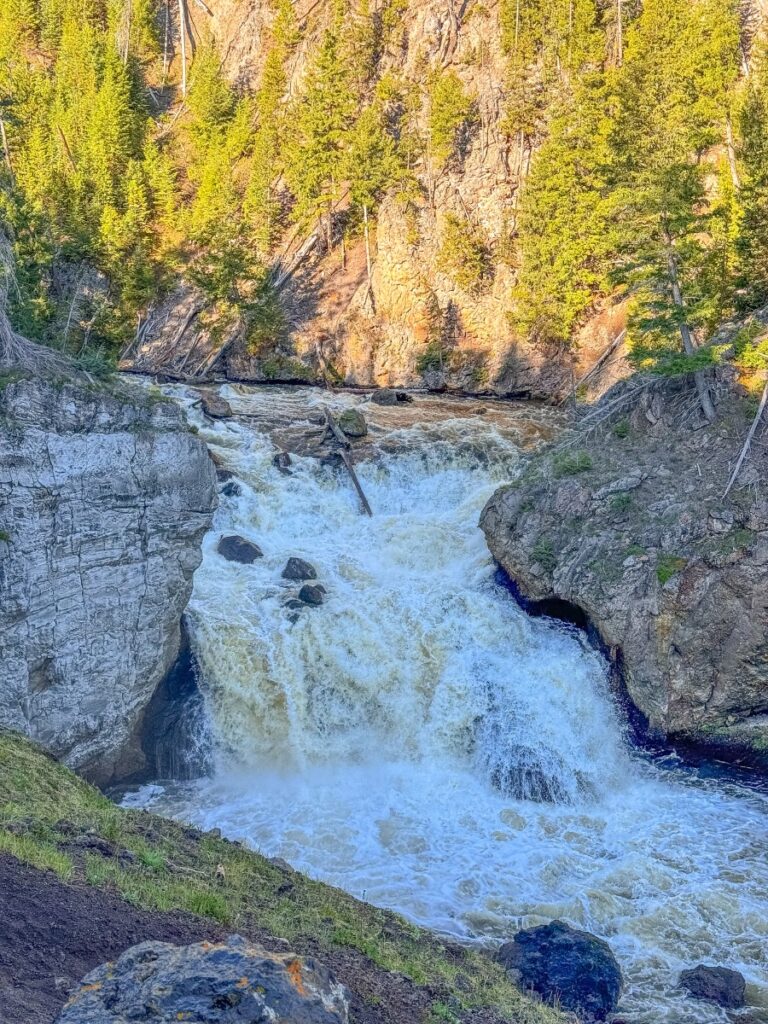
Firehole Canyon Road is a short scenic detour off the main road — just a couple of miles — that takes you along the Firehole River through a beautiful narrow canyon.
There’s a waterfall stop (Firehole Falls) where you can pull over and take photos without any hiking required.
💡 PRO TIP: There’s also a swimming area a little further along the Firehole River — a rare spot in Yellowstone where you can actually swim, thanks to the warm water mixing in from the hot springs.
Back to West Yellowstone
🚗 Driving time from Firehole Canyon: ~40 min
And just like that — your three days in Yellowstone are complete!
Summary: 3-Day Yellowstone Itinerary
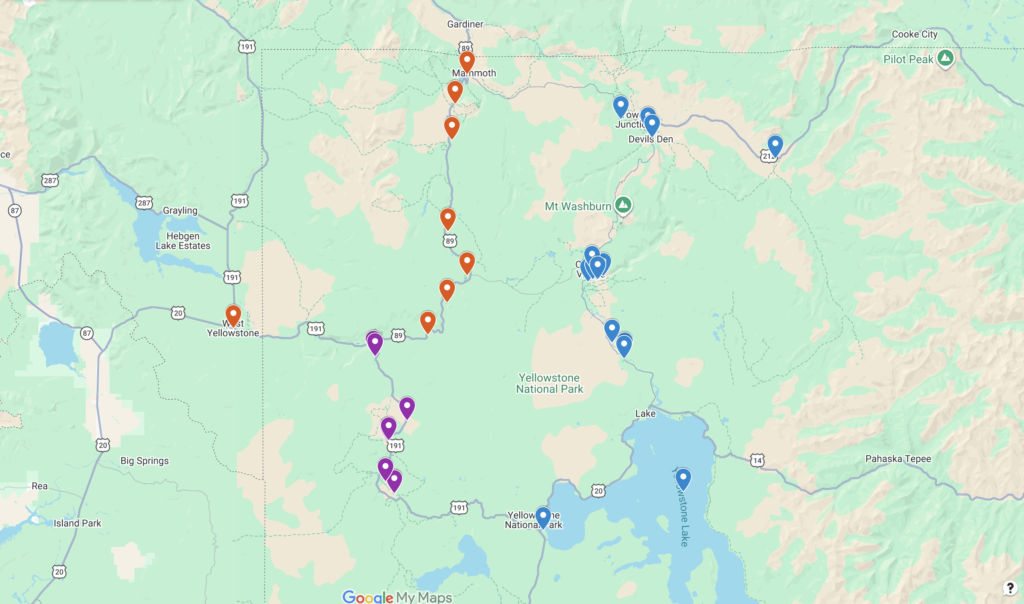
Day 1: West Yellowstone to Mammoth Hot Springs
Gibbon Falls → Artists’ Paintpots → Norris Geyser Basin → Roaring Mountain → Sheepeater Cliff → Golden Gate Canyon → Mammoth Hot Springs
Day 2: Lamar Valley, Grand Canyon & Yellowstone Lake
Petrified Tree → Lamar Valley → Calcite Springs Overlook → Tower Fall → Grand Canyon North Rim → Canyon Village → Brink of the Lower Falls → Grand Canyon South Rim → Hayden Valley → Sulphur Caldron & Mud Volcano → Yellowstone Lake → West Thumb Geyser Basin
Day 3: Old Faithful, Grand Prismatic & the Lower Geyser Basin
Old Faithful → Upper Geyser Basin & Morning Glory Pool → Grand Prismatic Overlook → Grand Prismatic & Midway Geyser Basin → Fountain Paint Pots → Firehole Falls & Firehole Canyon Road → West Yellowstone
Map of this Yellowstone 3-Day Itinerary
I hope this itinerary helps you plan an incredible first trip to Yellowstone.
It really is one of the most extraordinary places in the world — there’s nowhere else like it.
If you want to do some more planning before you go, check out everything you need to know before visiting Yellowstone, my Yellowstone packing list, and don’t miss the biggest mistakes to avoid in Yellowstone so you’re fully prepared.
