
Disclosure: This post may contain affiliate links, meaning I get a commission if you decide to make a purchase through my links, at no extra cost for you!
Dreaming of a road trip in Utah and want to discover the Mighty 5 national parks? Well, this article is for you!
This is one of my favorite road trips in the whole of the United States. In one loop you get five incredible national parks (Zion, Bryce Canyon, Capitol Reef, Canyonlands and Arches), some of the most scenic roads in the country and, if you want it, a few bonus stops along the way including state parks as well as national monuments.
You can even go to the Grand Canyon on your way back to Las Vegas if you want to!
While you can start that road trip from other locations, Las Vegas is very practical for most people as it’s home to one of the best airports and you can easily rent a car and drive to the first national park from there.
After spending months planning the perfect Utah and Arizona road trip, I’ll walk you through the full route I recommend from Las Vegas, with all my tips, the drive times between each stop and a couple of options for the way back.
As always though, please make it yours. This is your trip and while I’ll share all my personal experiences, I want to help you make the most of it and make it yours!
🚗 Good to know
A few things before you set off.
- You’ll need a car. I always compare prices on Discover Cars to find the best deal in Las Vegas. An SUV works for this route but I find that having a 4×4 high clearance vehicle is better for peace of mind.
- Get yourself an America the Beautiful pass. It covers all five national parks plus the national monuments along the way. Just note it does not cover the state parks (like Valley of Fire in Nevada, or Snow Canyon and Sand Hollow in Utah), which charge their own fees.
- I really recommend the GuideAlong App. It plays commentary as you drive and is packed with tips. There’s a Southwest bundle that covers most of this route, and it was worth every penny for us.
- Start your days early. The light is better, the parking is easier and you beat both the crowds and the midday heat.
- Carry way more water than you think you need, plus snacks and sun protection. The desert is no joke, especially in summer.
🗺️ The route at a glance
Here’s the full loop so you can picture it before we dive in:
- Las Vegas (your starting point)
- Optional detours: Valley of Fire, Snow Canyon, Sand Hollow
- Zion (about 2.5 hours from Las Vegas)
- Bryce Canyon (about 2 hours from Zion)
- Capitol Reef (about 2.5 hours from Bryce along Scenic Byway 12)
- Canyonlands, Island in the Sky (about 2.5 hours from Capitol Reef & 40 minutes from Moab)
- Moab (your base for the last two parks)
- Arches (about 5 minutes from Moab)
- Return to Las Vegas (two options, see the end)
You could rush it in about 7 days, but I’d give yourself 10 if you can.
🎰 Stop 1: Las Vegas


The easiest airport to fly into is Las Vegas. It’s one of the largest airports in the country and it’s one of the easiest destinations to get to.
Also, it makes a fun start or end to the trip.
Even if you’re not a casino person, it’s worth spending a night here to get over any jet lag and you can start your trip the morning after. It’s also a bit safer in case your flight is delayed as it could be stressful to know you have to drive as soon as you arrive.
When you get to the airport, take the shuttle to the car rental offices. It’s very easy and only takes a few minutes.
As previously mentioned, I would recommend having a look on Discover Cars and see what the best deals are.
Once you’ve picked up your car, drive up towards the Strip where you can stop at the “Welcome to Las Vegas” sign.

You can then keep driving up the Strip. This is a lot of fun as you get to see all the themed hotels and it’s honestly a lot more impressive from a car than it is on foot.
You can then check into your hotel and go for a wander along the Vegas Strip. From the gondolas of the Venetian to the beautiful fountain of the Bellagio, there is plenty to see!
Las Vegas is also the perfect place to do a big grocery shop before you head into the parks, where food options get limited and pricey.
We stocked up at Walmart and were glad we did.
Make sure to buy loads of water, Gatorade, snacks and anything else you may need.
Once you have everything, enjoy Vegas and in the morning start driving towards Utah.
🏜️ Optional stops between Las Vegas and Zion
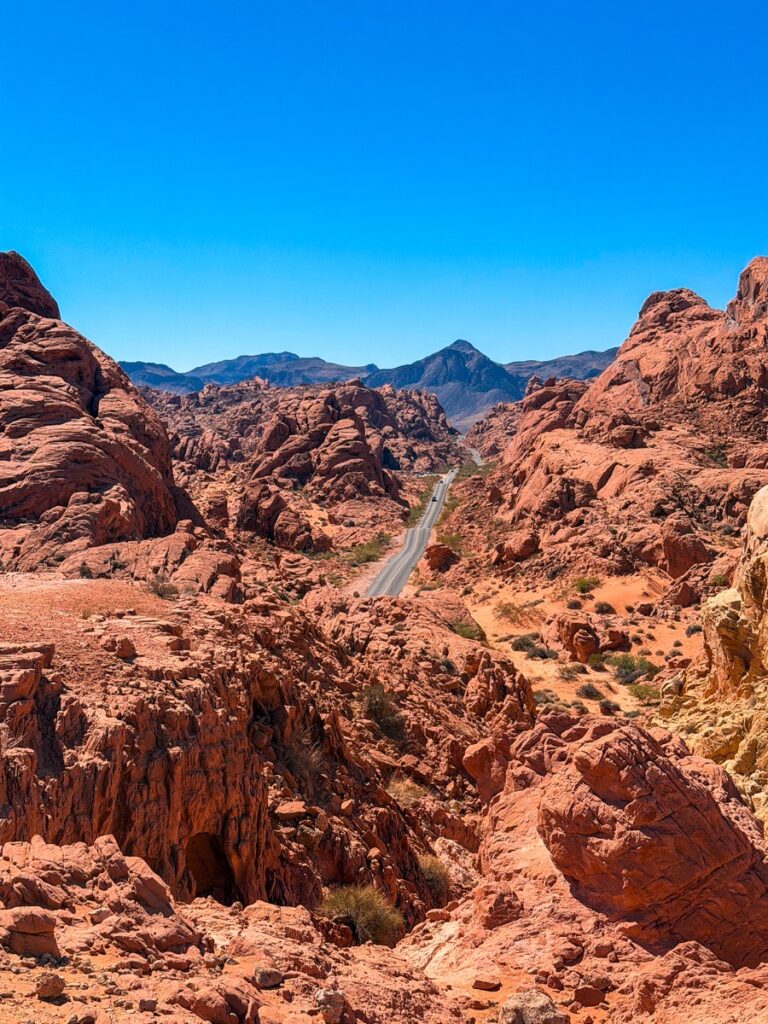

If you have extra time, there are a few lovely detours on the way to Zion.
Valley of Fire is a Nevada state park about an hour from Las Vegas, famous for its bright red sandstone and the Instagram-famous Fire Wave. It’s a wonderful half-day stop and it barely requires a detour.
Snow Canyon, just outside St George in Utah, is a quieter gem with red and white rock, slot canyons and sand dunes. It’s smaller and far less busy than the national parks.
Sand Hollow is another Utah state park nearby, built around a reservoir, so it’s a good one if it’s very hot and you fancy a swim or some water activities to cool down.
All three are state parks, so remember your national park pass won’t cover them. Sand Hollow is a bit pricey in my opinion so unless you really want to swim I would prioritize the other two.
⛰️ Stop 2: Zion National Park


Drive from Las Vegas: about 2.5 hours (160 miles)
Zion is going to be your first national park on this Mighty 5 road trip.
It’s the second most visited national park in the country and the busiest of this itinerary.
There are several areas to it but the one everyone visits is Zion Canyon which is a beautiful gorge carved by the Virgin River.
Once you get to the entrance, you’ll have to show your America the Beautiful pass (you can buy it there if you don’t have one). You will then be given a map with all the information about the park.
While there is a road and a scenic drive, it’s closed to private vehicles for most of the year which means you will have to take the mandatory shuttle.
It’s free and starts at the visitor center. I would recommend getting there early though as that parking lot fills up fast.
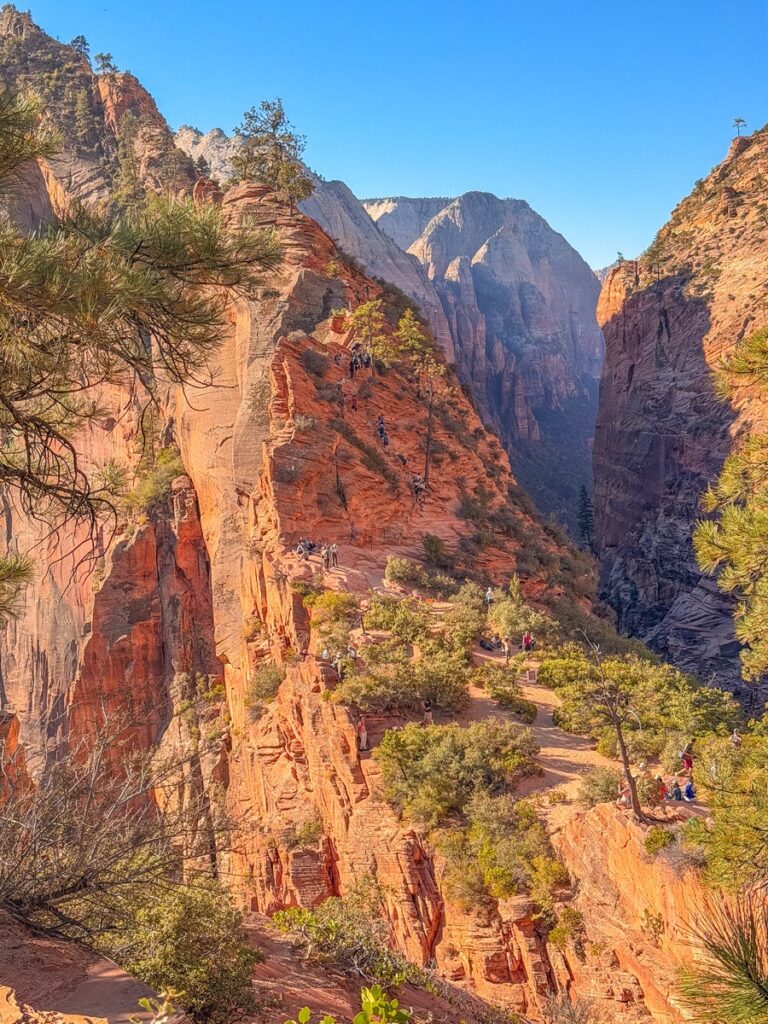

There is plenty you can do in Zion National Park but the two main highlights are: Angels Landing and the Narrows.
Angels Landing is a 5.4-mile hike (round trip) that goes from the bottom of the canyon up to Scout Lookout and onto a chained section to Angels Landing.
Please note that you will need a permit for the chained section however don’t worry if you don’t get one, you can always walk to Scout Lookout.
The Narrows is very unique as it’s a river walk. You walk up in the Virgin River and inside a narrow canyon. It’s truly magical and definitely one of the best experiences you can have.
If those feel like too much, there are gentler options like the Emerald Pools and the Riverside Walk that still show off the scenery beautifully. The Kayenta Trail is also a great option (and one of my personal favorites).
If you’d like to do a scenic drive, make sure to go to the Kolob Canyons and / or Kolob Terrace Road. It’s a lot quieter, you can use your own car and there are also some spectacular landscapes there.
I would recommend spending 2 or 3 days in Zion so you have time to do all the hikes. If you are not interested in hiking (or not much), then a day would be enough.
🏞️ Stop 3: Bryce Canyon National Park


Drive from Zion: about 2 hours (85 miles)
From Zion Canyon, drive through the Zion-Mount Carmel Tunnel and eventually reach Highway 89.
PRO TIP: There is a quick and easy hike you can do here so I would highly recommend it. It’s the Canyon Overlook Trail.
You’ll then turn onto Scenic Byway 12 and reach Red Canyon.
It’s a great place to stop and have a walk. There is a visitor center as well.
As you continue you’ll drive through 2 man-made arches which is pretty amazing.
Eventually you’ll reach Bryce Canyon City and can head to the entrance of the park.
Bryce Canyon is a lot smaller compared to Zion. It’s also a lot less visited but it still gets crowded around the amphitheater which is why you should consider using the free shuttle (though it’s not mandatory).
Since it’s a lot higher up, it can also be a lot colder, especially in the mornings. I would recommend packing layers as it can be very cold in the morning and very hot in the day.
Bryce is my favorite national park in Utah. It’s famous for its hoodoos and there is honestly nothing like it!


If you can manage an early start, I would recommend going to Sunrise Point to watch the sunrise.
From there, you can start the Navajo Loop and Queen’s Garden combo loop. It’s about 2.9 miles and takes 2 to 3 hours, and instead of looking at the hoodoos from above, you get to walk right down among them.
Keep an eye out for the famous ones as you go, like Thor’s Hammer and Queen Victoria.
There are also loads of viewpoints you should go to. The most famous ones are Inspiration Point and Bryce Point.
They are both stunning but I actually would recommend doing the Rim Trail from Bryce Point to Inspiration Point and back.
There are also a lot of viewpoints you can stop at on the scenic drive. This part of the park is quieter so keep it for the afternoon.
If you like horseback riding, I would also recommend doing one of the rides with Canyon Trail Rides.
It’s also worth noting that Bryce is a certified dark sky park, so if the sky is clear, stay up for the stars.
We booked a guided stargazing experience and it ended up being one of the most unexpected highlights of the trip. Seeing Saturn and its rings through the telescope was unreal.
🍑 Stop 4: Capitol Reef National Park


Drive from Bryce: about 2.5 hours (120 miles) along Scenic Byway 12
Once you’re done in Bryce Canyon, drive the Scenic Byway 12 to Capitol Reef.
While Google Maps might recommend another and quicker route, that would be a mistake as this drive is honestly one of the best in the United States.
I would recommend setting aside an entire day for that drive as there is plenty to do in Grand Staircase-Escalante National Monument including Escalante, Escalante Petrified Forest State Park, Lower Calf Creek Falls, the viewpoint at Head of the Rocks and the drive over the Hogback (a narrow ridge with drop-offs on either side).


Eventually Byway 12 ends at the little town of Torrey, and Capitol Reef is just a few minutes further on.
Capitol Reef itself is a lot quieter and after the crowds at Zion and Bryce, it feels wonderfully peaceful.
It’s known for its interesting geological features, cliffs and the historic Fruita orchards, where you can pick your own fruit.
Another highlight is the Gifford House and their delicious homemade pies! They’re famous for a reason and tend to sell out before noon so make sure to go as early as you can. My personal favorite is the mixed berry but they are all great.
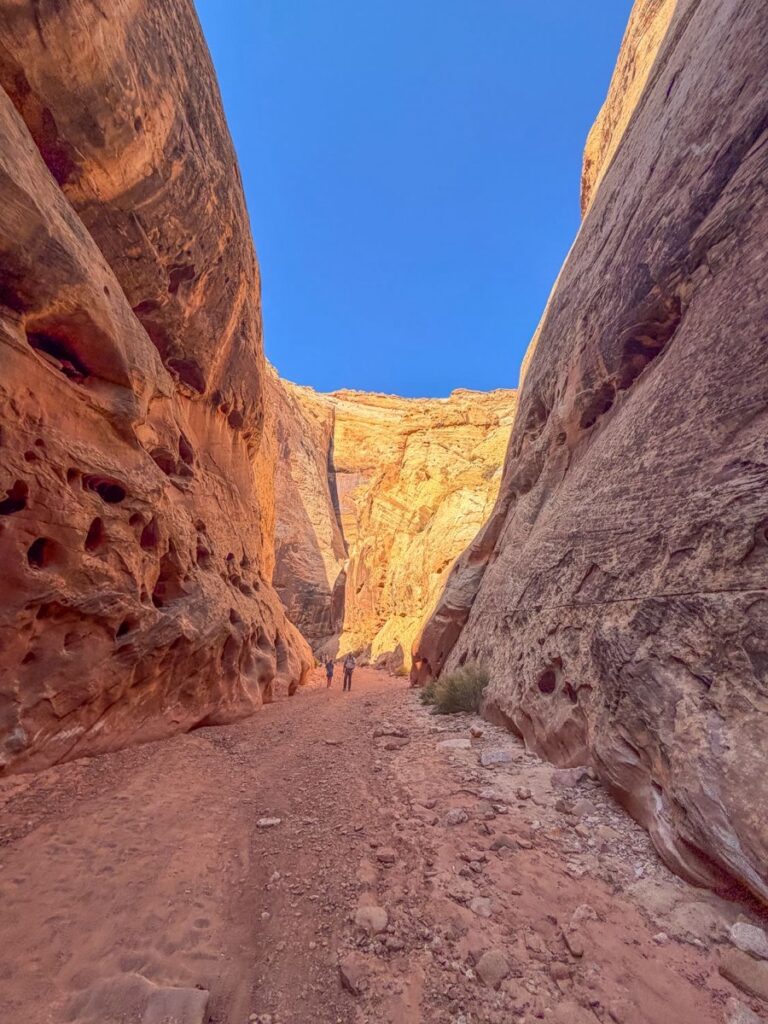

There are quite a few hikes you can do in Capitol Reef including the Grand Wash (easy and highly recommended), Hickman Bridge, Cassidy Arch and Chimney Rock.
If you have a high clearance vehicle, drive down Capitol Gorge Road. It’s beautiful!
Finally, make sure to go to the Fruita Schoolhouse, the orchards and the petroglyphs panel.
🏜️ Stop 5: Canyonlands National Park (Island in the Sky)

Drive from Capitol Reef: 2 hours 30 minutes
From Capitol Reef, follow Highway 24 east and then join the I-70 before dropping down towards Moab.
The entrance of the Island in the Sky district of Canyonlands is located before Moab so keep an eye on it.
Canyonlands is the biggest of Utah’s national parks and yet the least visited of them which means that it’s a lot more peaceful compared to Bryce and Zion.
The park is split into separate districts. For this trip, Island in the Sky is the one to head for, as it’s the closest to Moab and the easiest to see in a day.
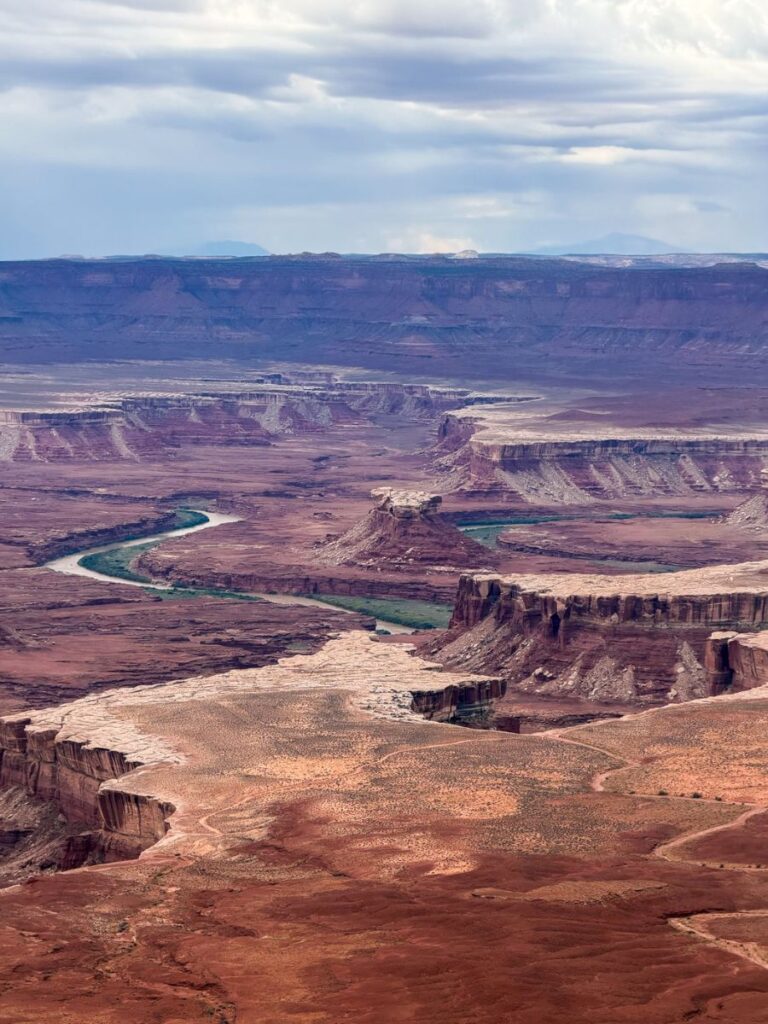
It sits high on a mesa, with jaw-dropping views out over the canyons carved by the Green and Colorado Rivers.
It honestly feels like you’re on top of the world up there and you’ll understand why it was named like this as you drive around.
There are many things you should see in Canyonlands.
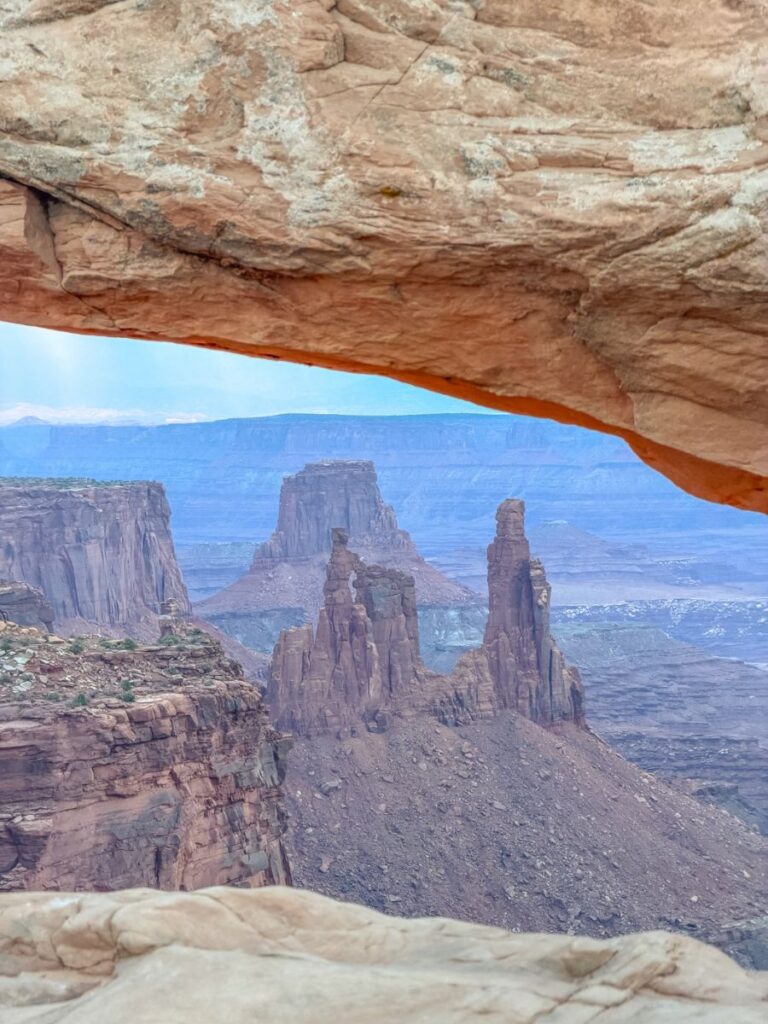

The most famous spot is Mesa Arch. It’s the only accessible arch in this park and it’s a great sunrise point as it perfectly frames the sun as it goes up. It does get very busy, so get there early and find yourself a spot to the side.
Grand View Point and the Green River Overlook give you some of the best views of the entire trip. Both viewpoints are easily accessible but I would recommend doing the Grand View Point Overlook and Trail. It’s pretty easy and the views of both sides of the island are so beautiful.
There is one other thing that Canyonlands is incredibly famous for and if you have a 4×4 high clearance car, you should definitely consider it. It’s the Shafer Trail.
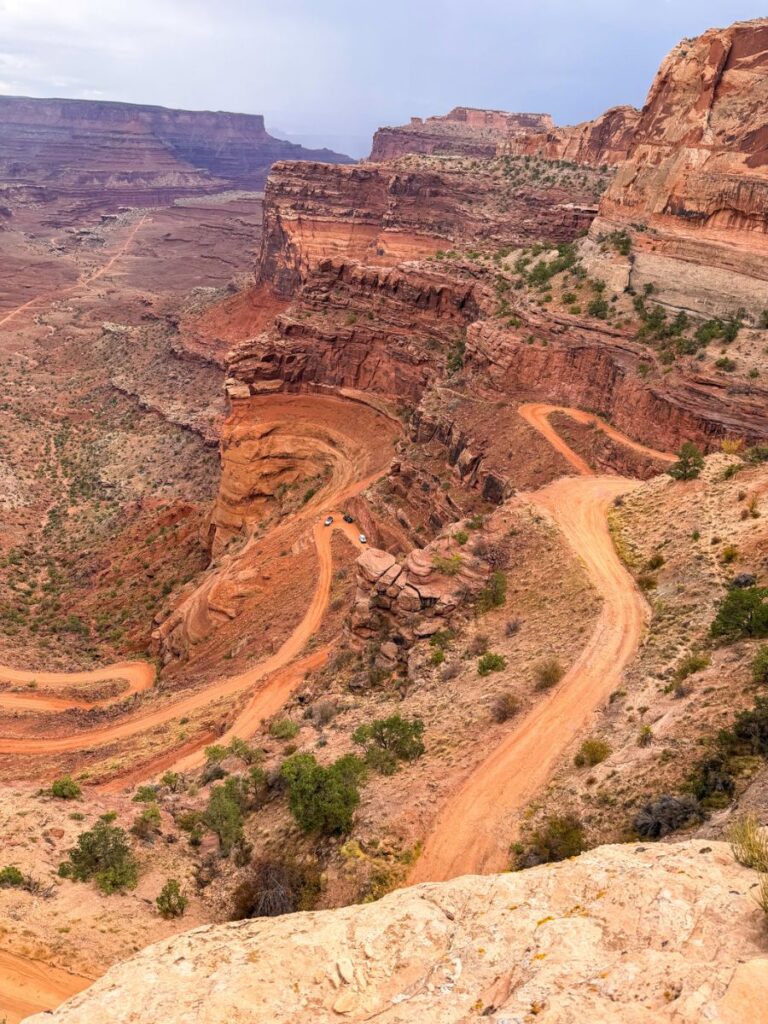

The Shafer Trail is one of the most famous roads in the United States. It’s a dirt road that consists of a series of switchbacks. It goes all the way from the top of the mesa in Island in the Sky, down to the bottom of the canyon and joins the unpaved section of Potash Road.
While this is a thrilling road to drive, you will need an appropriate vehicle and to bear in mind that you will need at least 3 hours to make it to Moab via Potash Road.
Finally, if you have a little extra time, Dead Horse Point State Park is right on the way back to Moab and has an incredible overlook of its own (just note it isn’t covered by your national park pass).
🏕️ Stop 6: Moab


Drive from Canyonlands: about 40 minutes
Moab is the adventure capital of Utah and the perfect base for your last two parks, as it sits right between them.
Since you left Las Vegas, you probably noticed that all the towns where you stayed were quite small. While Moab is not a big city, it’s definitely a proper little hub and there is plenty to do.
Here you’ll find loads of restaurants, bars and shops. I love the food truck park and spent far too long in the local bookshop.
It’s also the launchpad for all sorts of adventures. If you don’t have a 4×4 and still want to drive the Shafer Trail, Moab is a great place to hire a jeep or buggy.
I’d recommend basing yourself here for at least two nights so you can do Canyonlands and Arches without rushing.
🌉 Stop 7: Arches National Park

Drive from Moab: about 5 minutes
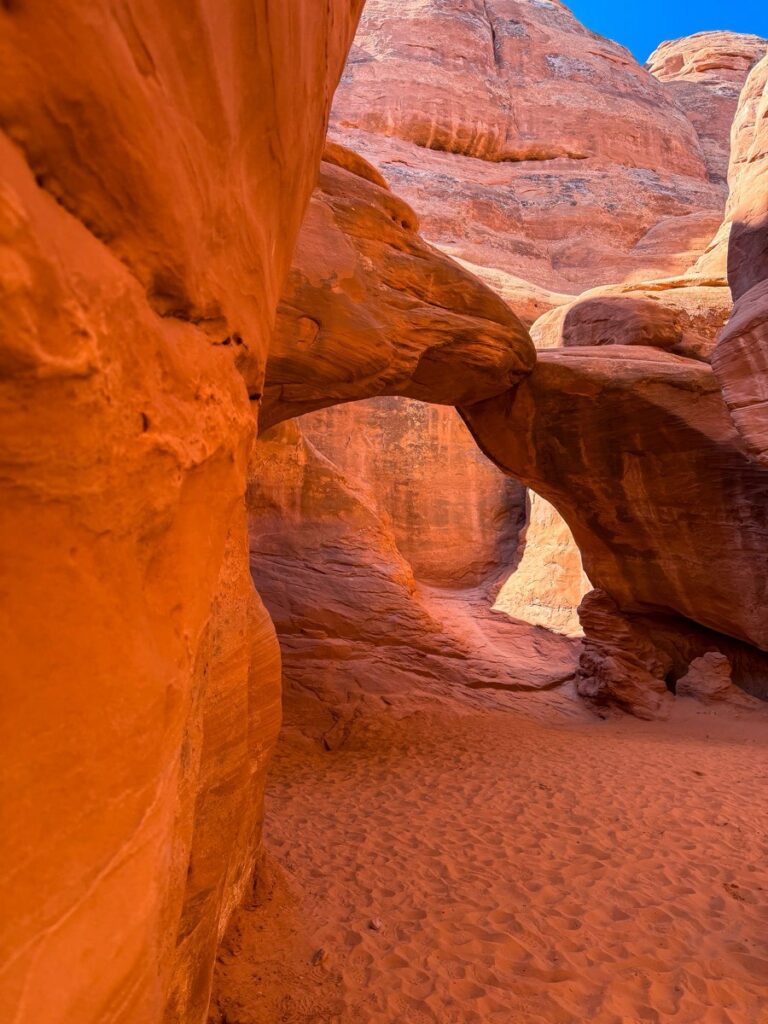
Arches National Park is right on Moab’s doorstep and home to more than 2,000 natural stone arches.
It is a small park and it gets crowded quite quickly so I would highly recommend getting there as early as possible. If you can head there for sunrise, do. You will be glad you did.
The most famous arch is Delicate Arch. You will recognize it from Utah’s license plates.
The hike is about 3 miles round trip. It’s a moderate hike but the arch is definitely worth it. It’s one of my favorite hikes in Utah!
I would recommend going there as early as you can. It’s a busy place and the trail is exposed which means it becomes very hard with the heat.


Other favorites of mine were Landscape Arch (one of the longest arches in the world), the Windows section and Double Arch, and the best part is that most of them are pretty quick, easy walks.
Give it a full day to enjoy the highlights without feeling rushed.
🚗 The return journey
Once you’ve finished at Arches, it’s time to head back to Las Vegas. You’ve got two main options depending on how much time you have.
Option 1: Via Monument Valley and Page (best value for your time)


If you can spare the extra days, this is the route I’d choose. Rather than retracing your steps, you loop south through Arizona and get to visit some of the most iconic landscapes in the American West.
From Moab you’d head down towards Monument Valley, with its unmistakable red buttes that you’ll recognize from countless films.
Don’t miss Forrest Gump Point on the way, for that famous photo of the road stretching out towards the buttes.
For a quieter option, the Valley of the Gods is free and such a beautiful hidden gem. It’s also located next to the Moki Dugway which is also an iconic road (and a lot less challenging than the Shafer Trail).
From there, carry on to Page where you can go to Horseshoe Bend and Antelope Canyon, one of the most beautiful slot canyons in the world.
From there you can head back to Las Vegas or even take another detour to Grand Canyon South Rim and Arizona’s Route 66 (though you’ll need an extra 3 days to do that).
Option 2: Via I-15 and I-70 (quickest)
If you’re short on time, the fastest way back is to take I-70 west and then I-15 south straight down to Las Vegas.
It’s a long day of driving (roughly 6.5 to 7 hours without stops), but it gets you back efficiently. You could always break it up with a night somewhere along the way if you’d rather not do it all in one go.
🗺️ Map of this Utah Mighty 5 Road Trip

💡 A few final tips
- Book ahead in peak season, especially accommodation in the smaller towns and anything that needs a permit.
- Fill up on gas whenever you can, as stations get few and far between out here.
- Download offline maps as cell signal is patchy in the parks.
- Keep your schedule flexible. Weather, closures and tiredness all happen, and the best trips leave a bit of breathing room.
❓ How long do you need for the Mighty 5?
You can technically do the loop in about a week if you move quickly, but I’d really recommend giving yourself at least 10 days if you can.
That extra time means you actually get to enjoy each park rather than just driving between them. It’s a lot of ground to cover, but it’s honestly one of the most rewarding road trips out there.
🔗 You May Also Be Interested In:
